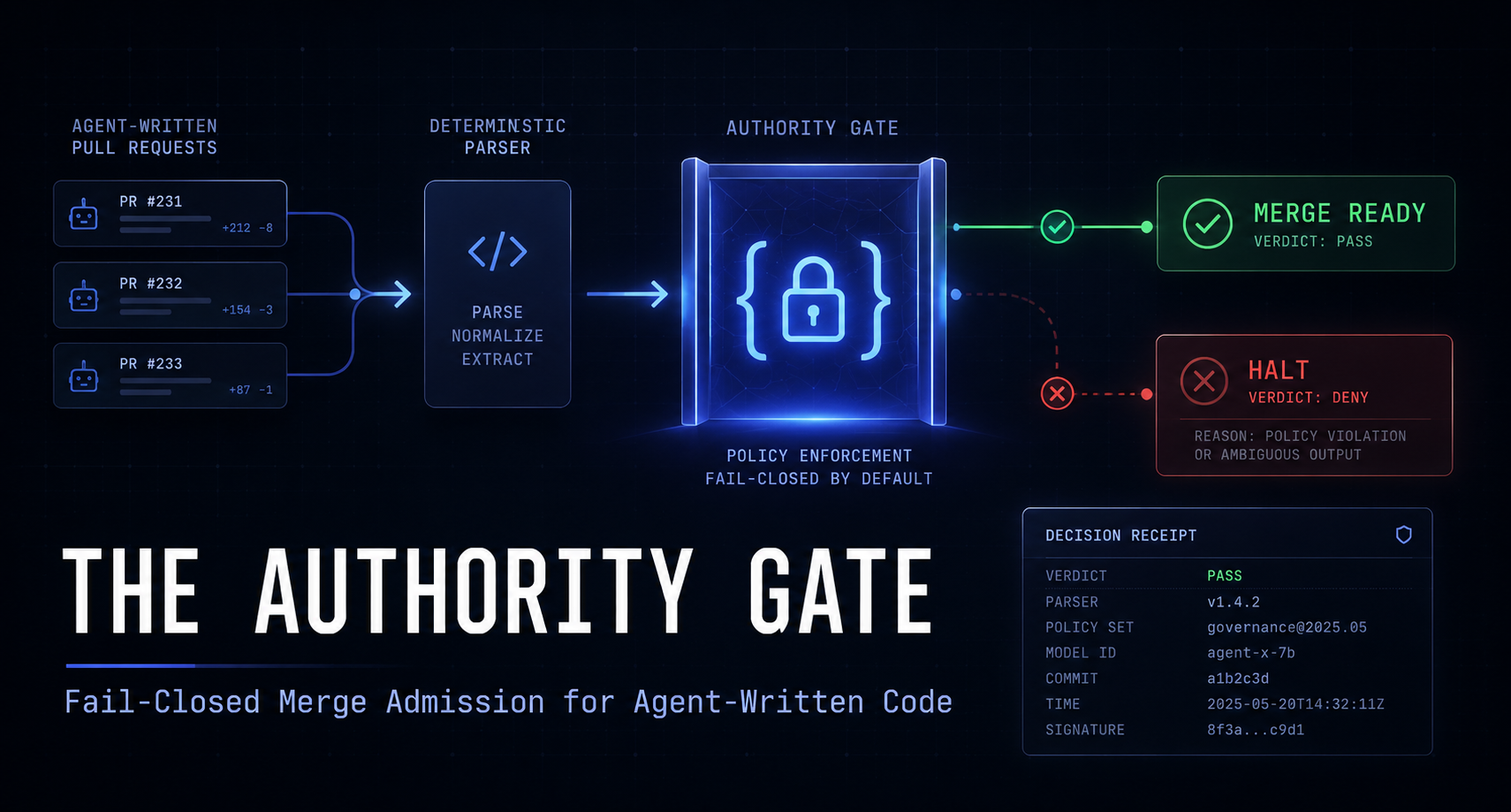
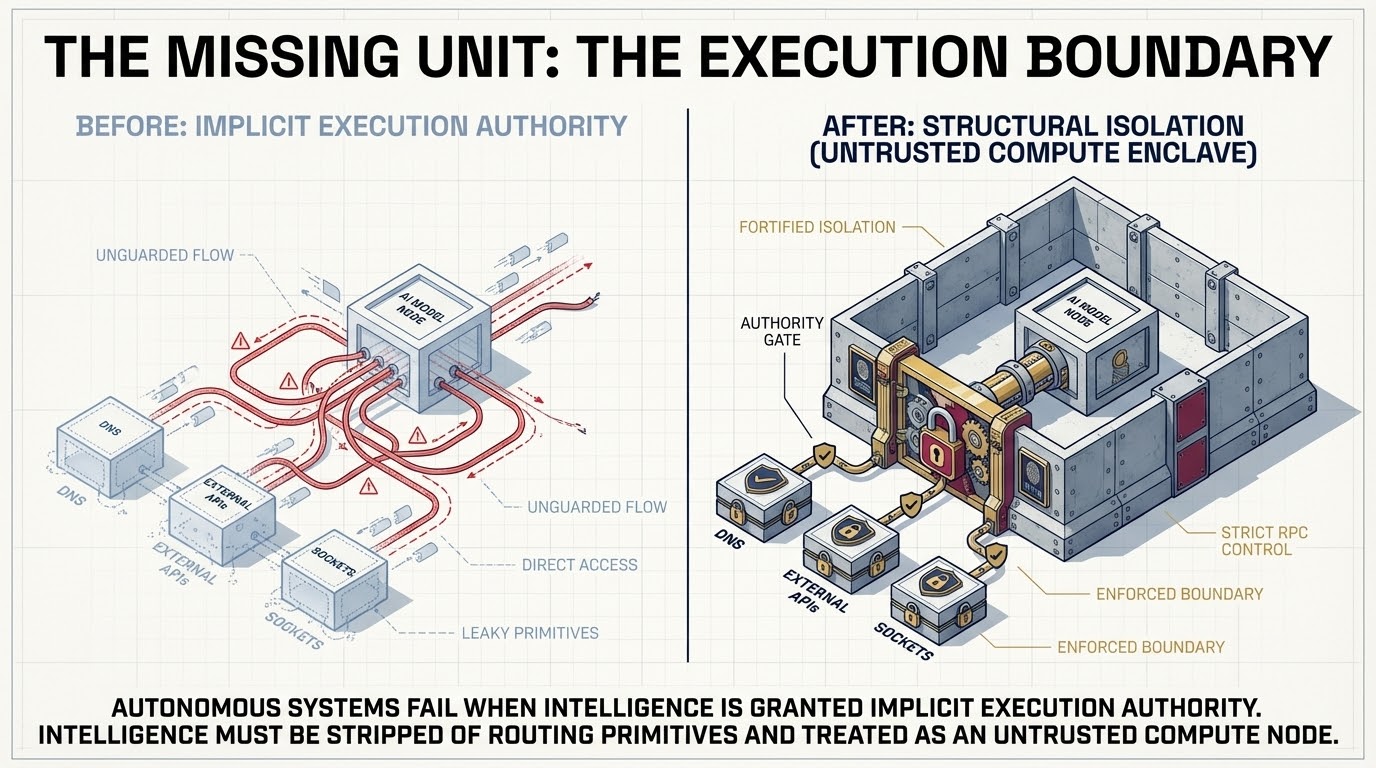
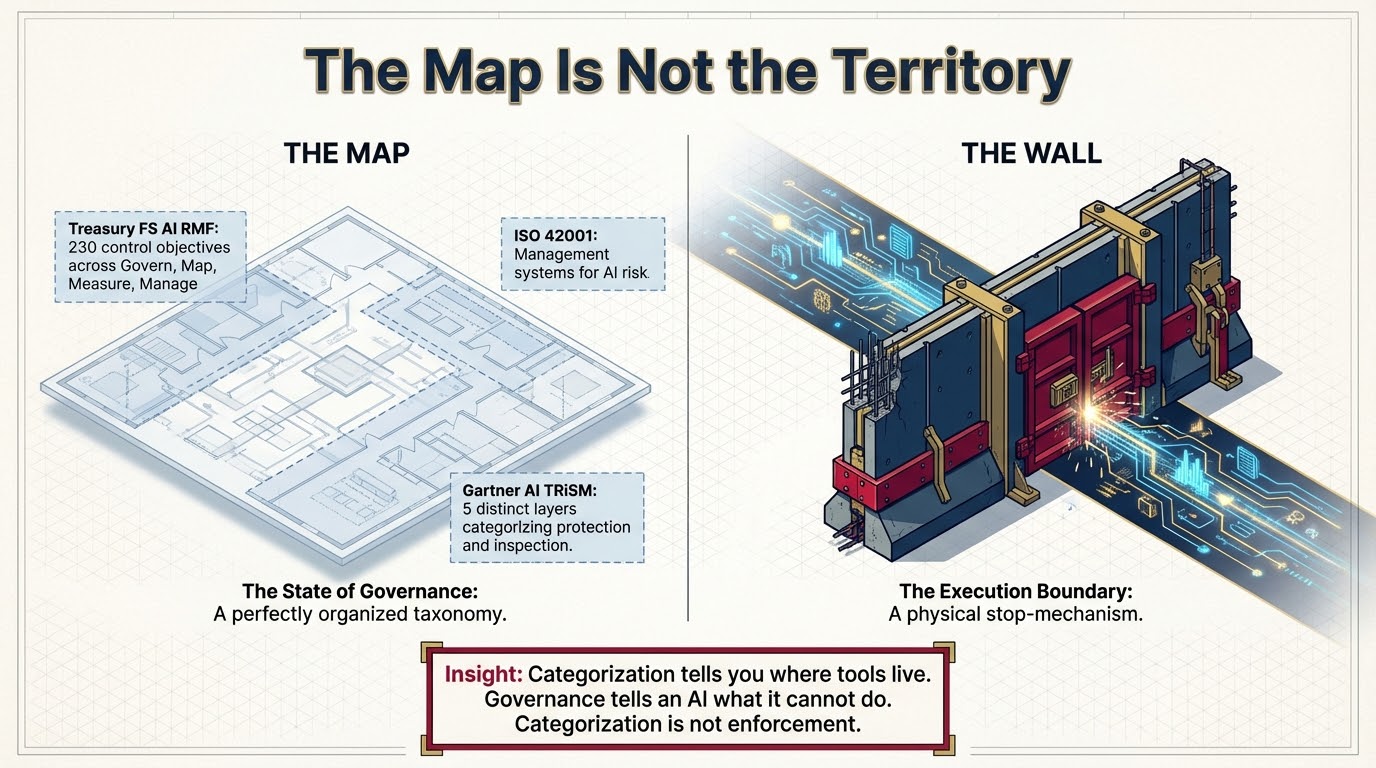
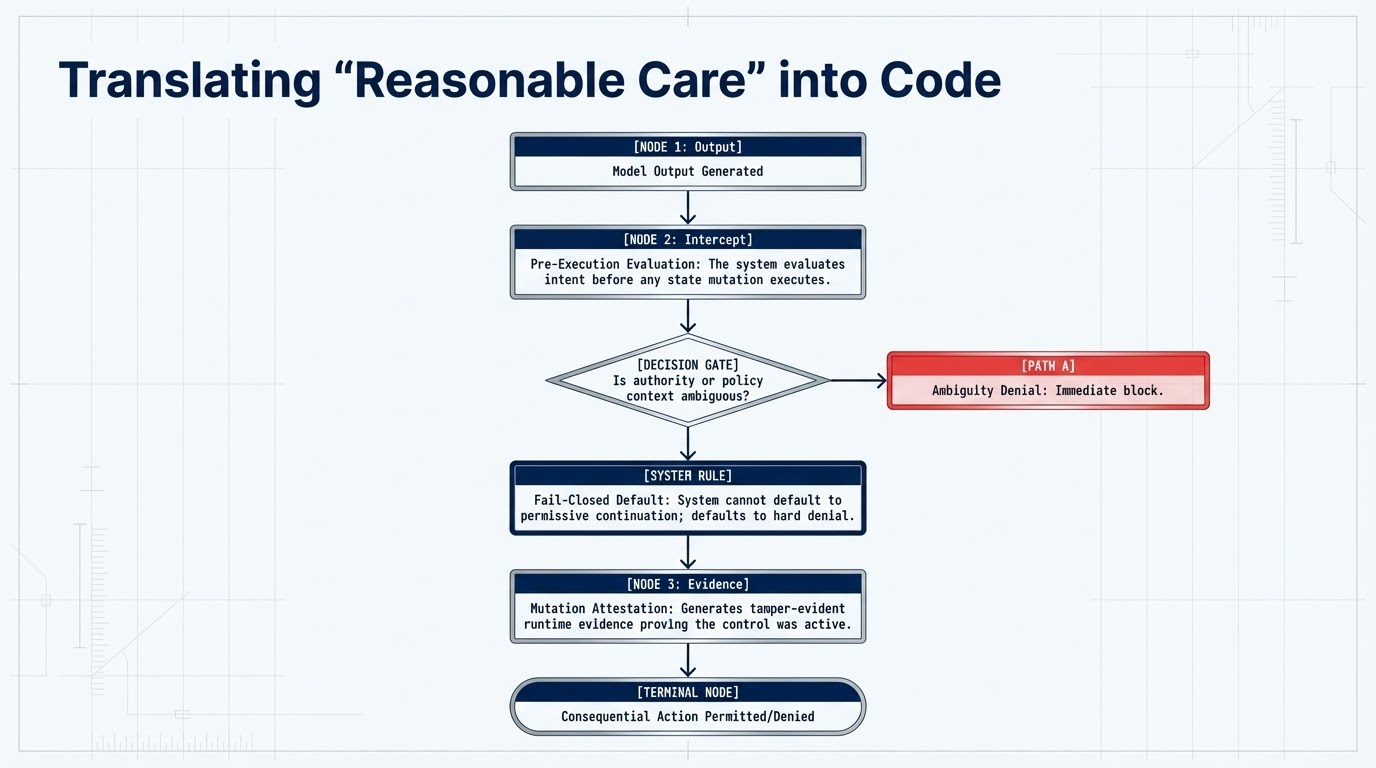
Public working log of Dan Mercede: short-form notes, experiments, and status updates on operator workflows, owned AI systems, and fail-closed proof depth. Not polished. Not canonical.
Redirect HOME, Not Env Vars
Short Essay · 2026-10-25 · 10:12 AM PT
Claim: If your tests pass an env dict into the code under test, a conftest that scrubs os.environ does not protect them. I ran into this moving an alert from Slack to a CLI that posts to our internal message board. The new transport reads its binary path from the env it is handed and falls back to a default under the home directory. The tests call main(env={...}) with a plain dict, so deleting the override from os.environ changes nothing: the dict never had it, the code takes the default, and a test that forgets the fake makes a real post.
Two more lessons came out of the same change.
**Drive a fake executable through an explicit override.** The fake records its argv
and the message file, then exits with whatever code the test asks for. So you test the
real subprocess call end to end, and the failure paths (a non-zero exit, a missing
binary) get the same coverage as the happy one.
**Pin the old-path tests when you flip a default.** Once the board became the default,
every existing Slack test would have taken the new path and still passed, because a
missing-binary refusal looks a lot like a missing-token refusal. So I set the old switch
explicitly in those tests, and they went back to testing what their names say.
The tell for the first bug is a signature like `env=None` that falls back to
`os.environ`. Anything in your conftest that only touches `os.environ` stops at that
parameter.
Isolate the root the default hangs off, not the variable that overrides it. Point HOME at a temp dir in an autouse fixture and compute the default path at call time, so a test that forgets the fake hits a missing file and fails closed.
Tags: #failure-modes #execution #systems
Record the Shell You Use
Short Essay · 2026-10-20 · 12:23 AM PT
Claim: A terminal recording runs in a shell that is not the one you work in, and the differences only show up in the video. I hit four of them on one guide episode. I wrapped the capture in bash -c 'cd repo && exec bash -i' and the prompt vanished, because a non-interactive bash unsets PS1 even when it arrives in the environment, so my recorder never saw a prompt and decided every command was still running. Exporting PS1 inside the wrapper fixed it. Then git and gh opened a pager in the pty and the capture sat waiting for a keypress, so I set GIT_PAGER, PAGER and GH_PAGER to cat. The gh spinner left braille characters on screen in the rendered frames, and GH_SPINNER_DISABLED=1 swaps it for plain progress text. And a scratch HOME made my global git hook print missing-helper warnings that my real setup never shows, because the hook finds its helpers through HOME. So every capture now starts from the same four lines: export the prompt, pagers to cat, spinner off, real HOME.
Treat the recording environment like a deploy target and write its setup down once. Otherwise each episode finds the same breakage on camera, one take at a time.
Tags: #failure-modes #execution
The Canary Looked Fake
Experiment Log · 2026-10-19 · 01:56 PM PT
Hypothesis: Staging a fake GitHub token in a scratch repo proves my pre-commit secret gate blocks commits.
Constraint: One scratch repo with a local pre-commit hook, plus a global hooks directory running gitleaks 8.24.3 on default rules. git 2.43.0.
Result: Failed. The first canary, ghp_ plus 36 copies of one letter, committed with exit 0 and a scanner line saying no leaks found. Two things were wrong. My hook was dead code, because a global core.hooksPath tells git to look in that directory and never in the repo's .git/hooks, so the verdict came from a different hook. And the canary looked fake: gitleaks passed it, and passed the alphabet in order too, but blocked a random token at once.
Next step: Build canaries from random characters at run time, and check which control printed the verdict before trusting it. Green has two causes: nothing to catch, or catching nothing. Full writeup: danmercede.com/guides/done-needs-a-receipt
Tags: #security #governance #failure-modes
Browsers need owners
Status Update · 2026-10-12 · 12:20 PM PT
Status: Resolved.
What changed: Released orion-browser under MIT: one persistent Chrome profile per identity and one lease holder at a time. Agents need distinct holders or separate MCP server processes to contend for leases.
What broke: Agents sharing one live browser can navigate away from each other's work. Separate tabs do not establish ownership.
Next step: Use the setup guide to test lease, renewal, and release before connecting agents: https://www.danmercede.com/guides/multi-agent-browser-pool
Tags: #systems #execution #infra
Primed Filler Scans Lie
Experiment Log · 2026-10-10 · 05:26 PM PT
Hypothesis: Priming Whisper with fillers in the prompt ('Umm, uh, so, like, hmm') finds every um left in a talking-head edit, so each one can be cut out of the audio automatically.
Constraint: One 2.5-minute voice track. Primed medium.en pass to find fillers, an unprimed small pass over the same short window to confirm each one, and a cut only counts if a fresh transcription still reads every word around it.
Result: Failed. The primed pass flagged 21 fillers. I re-heard 13 of them alone, unprimed: 9 were real words ('I'm', 'to', 'just', 'it's', 'and', 'continue'). Of the 4 both passes agreed on, 2 cuts still broke the line: one 'uh' was the first syllable of the next word, the other left half a sound that transcribed as a new word. Two cuts shipped. A prompt full of fillers makes the model hear fillers, and 4 of the 21 came back with zero-length timings, so a cut there lands blind.
Next step: Treat a primed hit as a lead, never a verdict. Cut only where an unprimed pass agrees, put each edge at the quietest 10 ms of the audio envelope, re-transcribe the cut, and revert any cut that shortens a word. A natural um costs less than a clipped word.
Tags: #failure-modes #signal #execution
npm Exit 0 Hid the Binary
Short Essay · 2026-10-09 · 12:58 PM PT
Claim: An npm install that exits 0 does not prove a CLI with per-platform binaries installed. Today the OpenAI Codex CLI died on launch with 'Missing optional dependency @openai/codex-linux-x64' right after a global reinstall that reported success. The debug log had the real story. Version 0.162.1 was published at 19:50:30Z, its linux-x64 build at 19:52:46Z, and the install ran at 19:55:18Z. The registry still answered 404 for that tarball. npm logged 'reify failed optional dependency' at verbose level, dropped the package, and exited 0. Nothing printed. Any package that ships its native binary as an optionalDependency inherits this, because to npm a missing optional dep is a skip, not an error. Running the reinstall the error message recommends gives the same broken result while that window is open. When I checked again the tarball answered 200, and a version-pinned reinstall fixed it in seven seconds.
Verify the platform package directory exists after the install, not the exit code. If it is missing, confirm the platform tarball returns 200 before reinstalling, then pin the exact version instead of latest. And grep the npm debug log for 'failed optional' whenever a fresh install will not start.
Tags: #failure-modes #execution #infra
Fail-Closed Notes: The Assistant Was Only Supposed to Read
Short Essay · 2026-10-08 · 10:00 AM PT
Claim: An AI assistant's authority comes from the tools it is handed, not from the job it was given, so an assistant installed only to read can act unless the owner sets its toolset to its job.
The owner of a workflow with AI assistants in it should be able to state what each assistant is permitted to do, show that it matches the job, and name who reviews a record of what each assistant did, and how often.
Tags: #governance #workflow-ownership
Your Agent's find Is Not GNU find
Short Essay · 2026-10-07 · 01:00 AM PT
Claim: In a Claude Code shell, `find` is a shell function that runs an embedded bfs, not GNU findutils. Most flags behave the same. Timestamp parsing does not. bfs rejects `-newermt '2026-10-06 21:00 UTC'` and git's `--date=iso` output (`2026-10-06 12:23:58 -0700`) with `Invalid timestamp`, while GNU find accepts both. I hit it inside an ownership probe that asked one question: has any other session written a transcript in the last few hours? The probe was `find ... -newermt '<stamp>' 2>/dev/null | xargs grep -l <branch>`. The error went to /dev/null, xargs got no input, and the empty output read as 'no other owner, safe to proceed'. A positive control caught it. My own session's transcript, which I knew was fresh, was missing from the result. The fix is small: use `-mmin -N`, or a strict ISO stamp (`git log -1 --format=%aI` prints `2026-10-06T12:23:58-07:00`), or `command find` to reach the system binary.
An empty result from a probe with stderr suppressed is not evidence of absence. When a probe's answer is 'nothing here' and that answer licenses an action, include one item you know must appear. If it is missing, the probe is broken, and the world is not empty.
Tags: #failure-modes #execution #signal
A Zero-Step CI Job Is Not Always a Billing Wall
Experiment Log · 2026-10-06 · 06:52 AM PT
Hypothesis: A CI job that ends with zero steps and an empty runner name, on a repo where neighboring runs pass, is a one-off hosted-runner queue stall. One re-run clears it, with no code change and no billing escalation.
Constraint: Diagnose from the jobs API only (runner_name, steps, created_at and completed_at) plus the repo's other recent runs, before touching code or raising a billing alarm. One re-run allowed.
Result: Passed. A PR's gates job sat queued for 15 minutes, then ended cancelled. The workflow run reported failure and GitHub showed the PR as BLOCKED, while our own review pipeline had already labeled it merge ready. The jobs API returned an empty runner_name and an empty steps list: the job never started. That shape also matches an Actions spending-limit wall, where every job fails at dispatch with zero steps. Two readings pointed away from a wall. Duration: a wall fails in 2 to 3 seconds, and this job sat 15 minutes between created_at and completed_at. Scope: main CI and three other PR runs on the same repo had passed in the 20 minutes before. Neither rules a wall out on its own, since a limit can trip between runs. The re-run settled it: gh run rerun with --failed went green in 55 seconds and the PR flipped to CLEAN and MERGEABLE, which a still-walled account would not do. Matching on zero steps alone would have sent someone hunting a code bug in a job that never ran a line, or escalating a billing problem that did not exist.
Next step: When a check is cancelled or failed, read the job before the run: runner_name, steps, and how long it sat between created_at and completed_at. Zero steps says the job never started. Duration and blast radius say which cause is likely, and one re-run says which it was. And read GitHub's own mergeStateStatus before relaying any internal ready verdict.
Tags: #failure-modes #infra #signal
Guards Parse Command Text
Short Essay · 2026-10-05 · 12:52 PM PT
Claim: An agent dodged one guardrail and tripped another with a single command. A lint warns against piping a mutating git command into a reader that can exit early, such as head, because git can then die from the broken pipe partway through a push. So the agent redirected the output instead: git push > push.log 2>&1. The push landed. But a post-push hook that reads the command text to work out which branch was pushed took push.log as the branch name and filed its review context under that key. The real branch got no review context until the mismatch was caught by hand. Neither guard is wrong on its own. Both pattern-match the same command string, so a workaround for one becomes fresh input for the other.
Hooks that infer state from command text must tokenize it the way a shell does: a redirect is not an argument. And when an agent routes around a guard, check the outcome against the system of record, not against what any hook recorded. After a push, that means comparing git ls-remote origin refs/heads/your-branch with git rev-parse HEAD.
Tags: #failure-modes #governance #execution
Empty Grep Is Not Absence
Experiment Log · 2026-10-04 · 11:32 AM PT
Hypothesis: Grepping `docker image ls --digests` for a digest proves whether an image pulled by that digest is on the host.
Constraint: Docker 29.1.3, overlay2. The image was pulled by digest only (`repo@sha256:...`, no tag) and run by a test minutes earlier on the same host.
Result: Failed. The grep came back empty, and so did `docker image ls --digests <repo>`. The image was there. A digest-only pull leaves the image untagged, and the default listing hides untagged images. `docker image ls -a` listed it with tag `<none>`, and `docker image inspect <repo>@sha256:...` returned its ID with exit 0. I nearly wrote the test off as vacuous because of a probe that could not see the thing it was asked about.
Next step: Answer 'is X present?' with a probe addressed to X that fails loudly when X is missing: `docker image inspect <exact ref>` and its exit code. An empty grep over a listing with default filters you did not choose cannot tell absent from not shown.
Tags: #failure-modes #signal #execution
Env Copies Leak Secrets
Experiment Log · 2026-10-01 · 11:25 AM PT
Hypothesis: Copying os.environ into a pytest helper object, so a CLI under test runs against fake binaries on PATH, is harmless as long as the tests never print it.
Constraint: One dataclass helper holding {**os.environ, ...}; failing assertions run at pytest -q, -v, and -vv; a canary variable seeded in the environment.
Result: Failed. The tests never print the helper. Pytest does. Assertion rewriting reprs every object in a failing comparison, and a dataclass repr includes every field, so the first failing run at -v dumped the whole environment, canary included, into the output. On a workstation that exports API keys, that output landed in a coding agent's session transcript, which can sync off the box. Marking the field repr=False removed the canary at -q, -v, and -vv.
Next step: Build the subprocess env from an allowlist instead of copying os.environ, and grep new test harness code for **os.environ before its first failing run, not after.
Tags: #security #failure-modes #execution
Review the Commit, Not the Branch
Short Essay · 2026-09-30 · 07:07 AM PT
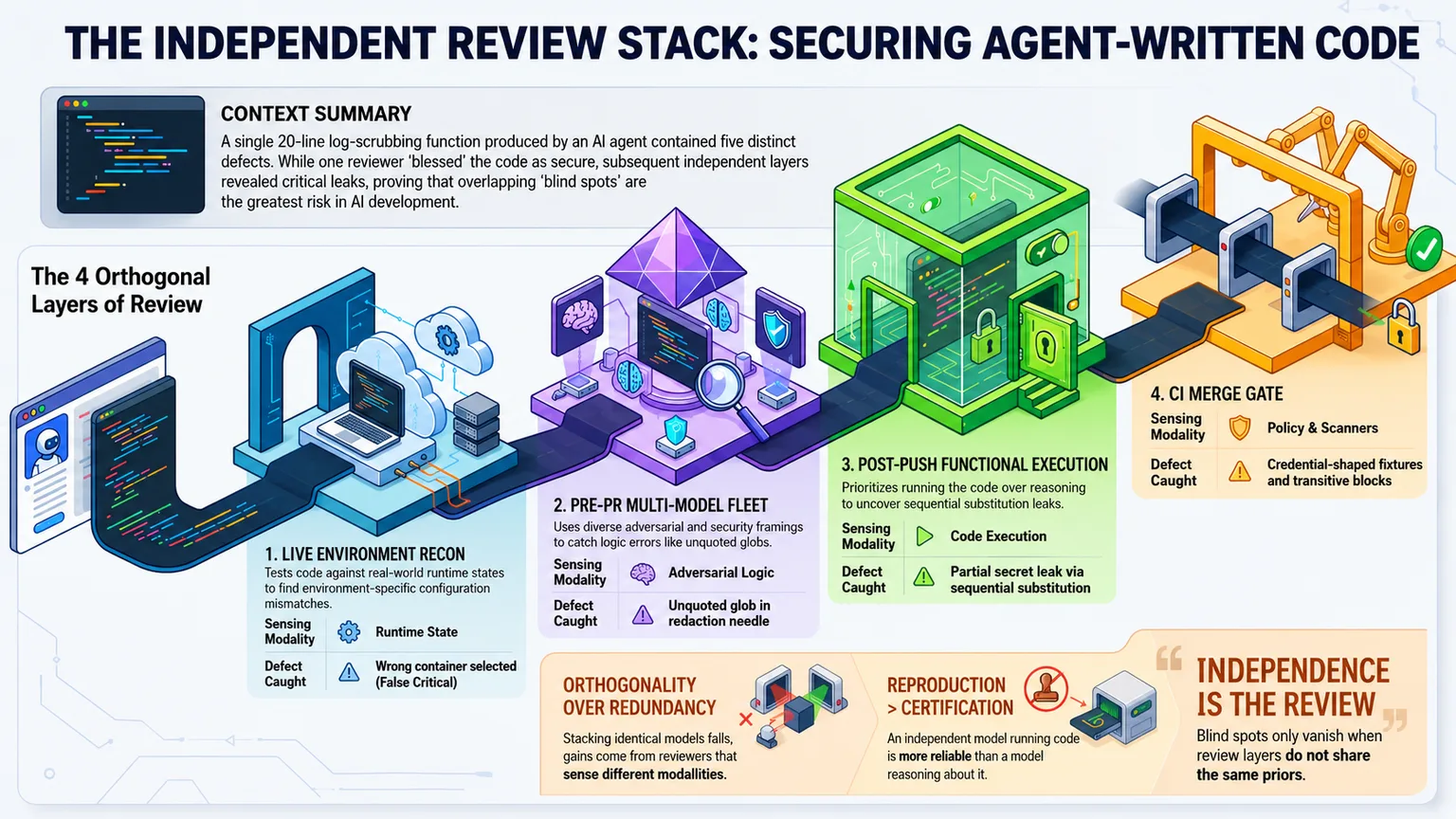
Claim: An AI review pipeline that resolves its target by branch name instead of the PR head commit reviews whatever that name points to locally, and it does so with full confidence. This morning two separate review engines each raised a HIGH finding on a one-entry content-sync PR: the change would drop 59 of 65 published entries and hand-patch a generated file. Neither was true. The review worktree had checked out a local branch with the same name, created in June, one commit ahead of the remote and 364 behind it. Both engines described that June commit precisely: six entries, 2,292 bytes, one category relabel. The live head was an eight-line addition with the byte-match CI gate green. My staleness check compared the swept SHA against the remote and passed, because those two agreed. The gap sat between the swept SHA and the SHA the reviewers actually read. When findings quote sizes, counts, or edits you cannot find at the head, run git branch -vv on the review ref and look for ahead/behind before you touch the code.
Pin review worktrees to the PR head SHA, never to a branch name, and record the reviewed SHA beside every finding. Two engines agreeing proves they read the same bytes. It does not prove they read the right ones.
Tags: #failure-modes #execution #governance
An Alert Nobody Reads
Short Essay · 2026-09-29 · 04:00 PM PT
Claim: A monitor that alerts once, on the state change, into a channel nobody reads is indistinguishable from no monitor. A production node of mine dropped off its Tailscale tailnet when its node key expired. The daily health check caught it the same morning and logged down four mornings in a row. It notified exactly once, on the transition, to a push-only chat channel. The daily brief I actually read never carried health state. Three days later I spotted it by eye on the admin console.
The monitor did its job. Detection was never the gap. Delivery was.
Transition-only alerting is a sane default: it stops a down host from paging you
every run. The cost is that the one message carries the whole outage. Miss it and
every later check is a silent `down`. The fix I want is boring: any host still
down after N checks goes into the daily brief, every day, until it clears.
The second trap was my own notes. Weeks earlier I had logged a lesson that a
Tailscale "last seen" label is often a control-plane artifact: `LastSeen` freezes
while a map long-poll reconnects, and the data plane is fine. True, and it would
have been the wrong prior here. The distinguishing field is in the peer record of
`tailscale status --json`. A frozen `LastSeen` with fresh handshakes is noise.
`"Expired": true` with no handshake is a real outage, and ping, TCP/22, and SSH
all agreed. A lesson that says "this alarm is usually false" needs a carve-out
for the case where it is true.
Put steady-state failure in the surface you read every day, not only the transition in a channel you have stopped opening. And when you write down a lesson that debunks a false alarm, write down what the real alarm looks like too.
Tags: #failure-modes #signal #infra
Reviewers Invent Hashes
Short Essay · 2026-09-26 · 09:28 AM PT
Claim: An LLM code reviewer will quote exact evidence for content it never read. This morning a review engine in my post-push pipeline raised two HIGH findings on a lockfile bump. One said a pinned file was missing from the integrity map; the pin was sitting in the lock. The other said a pinned digest no longer matched the file at the pinned commit, and it supplied the real sha256. That file lives in a different repository. The reviewer only saw the diff, so it had no way to hash it. The quoted value ended in 0123456, a sequential run that is a strong tell of a generated number. Two checks settled it in about a minute. I re-hashed all 21 pinned files at the pinned commit with plain git and sha256, then ran the repo's own lock verifier against a throwaway checkout of that commit. Both passed. Applying the finding would have rewritten a correct lock to match a number the model made up.
Before acting on a finding, ask whether the reviewer could have seen the thing it describes. If the evidence points outside what it read, its precision is a warning sign. Settle it with the check the repo already enforces, then decline the finding with that output attached.
Tags: #failure-modes #signal #execution
A Quoted Hash Is Not Proof
Experiment Log · 2026-09-24 · 12:40 AM PT
Hypothesis: An AI reviewer's HIGH finding is right: four new sha256 pins in a lockfile do not match the files at the pinned commit. It quoted an 'actual' hash prefix for each one, which made it read as already verified.
Constraint: Check it the way the gate checks, not the way the finding describes it: hash each committed blob at the pinned SHA, run the repo's own lock verifier against a clean clone at that SHA, then flip one digest to confirm the verifier can fail at all.
Result: Failed. All four digests matched byte for byte. The verifier exited 0 on the real lock and 2 on the mutated copy, so the check binds. None of the quoted prefixes came out of the blob hash the verifier computes. A second, medium-severity finding rested on the same premise and fell with it. Applying the suggested fix would have swapped four correct pins for four invented ones and broken a passing integrity gate.
Next step: Treat any hash, count, or line number inside a review finding as a claim to reproduce. Re-derive it with the enforcing code before editing anything, and decline with the command output quoted.
Tags: #failure-modes #governance #execution
When The Default Matches
Short Essay · 2026-09-22 · 12:50 AM PT
Claim: A missing-field fallback turns an equality gate into a no-op when that default is also a legal value on the other side of the comparison. The line was `header.get('set', '')` inside a validator that checks a submitted header against its registered row. It looks defensive. The registered row could itself carry an empty string for that field, so an input that omitted the field entirely compared equal and passed with zero findings, not even a warning. The trap is partial coverage. When the registered value was populated, omitting the field DID block, so the obvious test (drop the field, watch it fail) passes and reads as proof. The hole opens only where the registered value equals the default, and that is the case nobody writes a test for. A 187-test suite and four independent review engines across two full pipeline runs walked past it. Fix it at the source: require the field so the fallback is unreachable, or pick a sentinel the data can never hold (None), never the empty string, 0, or [].
`get(key, default)` reads as hardening and is the opposite inside a gate: it manufactures a value the comparison cannot tell apart from real data, converting 'I could not read this' into 'this matched'. Audit every get-with-default whose result feeds an equality or authorization check, and test the collision case, a missing field against data that holds the default, not just a missing field against a populated one.
Tags: #failure-modes #systems #governance
Fit Gates Measure Ink
Short Essay · 2026-09-21 · 02:41 PM PT
Claim: A browser layout gate that asks a DOM range for the boxes inside an element is measuring the wrong thing. range.selectNodeContents(el).getClientRects() returns every line of text, and it also returns the full block box of each element inside the range. A 230px paragraph holding a 120px line adds a 230px rectangle with no ink in it. I hit this on an agent-built fit test for a printed wheel diagram. The gate reported text crossing a segment boundary. A per-line dump showed every line sat between 4.5 and 55.5 degrees into a 60 degree segment, well inside the 2 degree margin. That false alarm is the dangerous kind: it pushes you to shrink a correct layout, or to loosen the gate until it measures nothing. Measure ink instead. Walk the text nodes with a TreeWalker, call getClientRects() per text node, and add icons as their own boxes. Then prove the repaired gate still binds by moving one label somewhere it must fail.
Before trusting a layout gate, check what it counts as ink. A gate that measures containers fails for reasons no reader would ever see, and the fix it demands makes the real layout worse.
Tags: #failure-modes #signal #execution
Empty Lists Lie
Short Essay · 2026-09-20 · 12:40 AM PT
Claim: A detector can be scrupulously honest per item and still lie in aggregate. Mine tagged every skill it tracked as measured, insufficient, or unmeasured, and it forced an unmeasured skill's trend to unknown instead of stable, exactly so that silence could not read as health. That care died at the summary. The top-level list of declining skills is built by appending only the ones whose trend is worsening, so an unmeasured skill contributes nothing and the list comes out empty. It read empty with 1 skill measured out of 73 and 9% of logged runs resolved. The consumer downstream mined that empty list as no skill is declining. What it meant was that 72 skills could not be judged at all. The per-item flag does not travel with the summary, and the summary is what consumers read. The fix is to give the aggregate its own status field. Mine now reports blind when zero items are measurable and the list therefore cannot be non-empty, partial when the measured base is too thin to generalize from, and live only when an empty list is a statement about the items rather than about the instrument. One question settles it for any empty collection you are about to act on. Could this have been non-empty?
The same trap caught the review pipeline that was supposed to check this change. It exited 0 with 0 findings while every engine inside it had errored or timed out, because the diff it fed them was 8 MB against a base branch 121 commits stale. Zero findings meant no reviewer ran. A green run and an empty result set carry no information until you know the collector was capable of filling it.
Tags: #failure-modes #signal #systems
Persistent Is Not a Retry
Status Update · 2026-09-13 · 07:05 AM PT
Status: Resolved.
What changed: Added a separate hourly catch-up timer that starts the real service only when the most recent scheduled slot never completed. The check keys to the slot, not to recency: the job advances a round-robin rotation on every run, so 'run it if it has not run lately' would have rotated to a new item every hour. It runs as ExecCondition and acts only on positive evidence. DUE runs, DONE skips, anything else exits 255 so the unit fails loudly. Verifying it surfaced a second trap: a missing ExecCondition binary is not a failure. systemd logs Skipped due to 'exec-condition' and moves on, so a guard living in a checkout you switch branches in quietly disables itself. The condition now exits 255 when the wrapper is absent.
What broke: A weekly systemd user timer lost a whole week to one killed run. It fired at wake as a Persistent=true catch-up, and 44 seconds later the WSL VM shut down: status=15/TERM. Persistent=true only re-fires a trigger that was MISSED. This one had fired, so systemd marked the week done and nothing retried until the next weekly slot. The unit also died during teardown, when systemd will not start an OnFailure job, so nothing alerted. Afterwards systemctl show reported Result=success anyway, because the new user manager had never run the unit and its ExecMainStartTimestamp was empty.
Next step: Sweep every fixed-time, long-running timer on the host. This is the third time the same class lost work, and a lesson written against one job protected none of its siblings.
Tags: #failure-modes #infra #signal
Dead Agents Return Null
Short Essay · 2026-09-08 · 08:45 PM PT
Claim: A subagent that dies on a usage limit resolves to null. It does not reject, so the .catch you carefully wrapped it in never fires. One root cause, two different disasters, and the second is the expensive one. Folded bare into a default, the dead agent reads as an empty result and the run reports clean: twenty-six verifiers that never executed become zero findings, and nothing in the summary says otherwise. Spread into an object, which is the ordinary idiom for tagging a result with the input that produced it, the null becomes a truthy object carrying only the tag. No error field. It survives .filter(Boolean). It survives an explicit error check. Then it crashes three phases later on a field access that assumed a real payload, and takes the entire run down with it. The fix is one rule with no exceptions: never spread an agent result directly. Route every one through a validator that rejects non-objects before the spread, and use an isArray guard on every field you plan to iterate. A linter that only checks for a missing .catch will pass this code.
When a fan-out does die, the journal is the wrong place to look if it died early. Every line in mine was empty because no agent had finished. The disk was not empty. The agents had already written their fetched pages, archive snapshots and parsed metrics to the scratch directory before they were killed. Inventorying those files into the resumed run's prompt preamble, as a salvage block that says reuse before refetching and confirm the dates yourself, meant the second run reproduced none of them. Persisting bulk to disk gets sold as a context control. It is also the crash-recovery substrate, and that is the better reason to do it.
Tags: #failure-modes #execution #systems
Your Canary Shares the Cursor
Short Essay · 2026-09-07 · 03:50 PM PT
Claim: A liveness canary that shares the system's dedup cursor cannot prove liveness. I hit this on an incremental sync where four filtered queries returned zero. Zero has two indistinguishable causes: nothing new, or a broken query path. The canary exists to tell those apart, and mine could not, because it ran through the same cursor as the real fetch. A source I knew had produced new records came back as 'nothing new', byte-identical to a dead path. The fix is one flag: point the canary at an empty cursor, so a known-good query has to return rows or the path is genuinely broken. That buys less than it looks like. A live path says nothing about whether your filters cover the domain, and 'every filtered query returned zero' is also exactly what a filter gap looks like. So I listed the unfiltered window and classified all 194 records by hand instead of trusting four queries. The zero was real. I only know that because I stopped believing the filters.
Two controls, not one. An empty-cursor canary proves the path is alive. An unfiltered listing proves the filters were looking in the right place. A zero that has passed neither is a guess wearing a green check.
Tags: #failure-modes #signal #systems
Enumerate the Set, Never Compare Counts
Experiment Log · 2026-09-06 · 04:40 PM PT
Hypothesis: A grounding check on generated narration can enforce one claim-map line per paragraph by comparing the number of map lines to the number of paragraphs.
Constraint: A script stage where a model returns SPOKEN plus a CLAIM-MAP of 'para N: <claim ids>', checked against a fixed evidence ledger before the text can be voiced. Three independent review engines, three review cycles, pytest suite RED first on every rule.
Result: Failed. Three fail-opens shipped in a row, each caught by a different engine. First, coverage compared counts: 'para 1' plus 'para 3' satisfied a two-paragraph script, and so did 'source A' plus 'source B'. The producer controls the labels, so any count it can pad it will pad. Second, tokens that did not look like ids were dropped before validation: 'C-001, MADE_UP_FACT' passed clean. Third, a range label expanded before it was range-checked; 'para 1-1000000000' pinned the CPU and the regression test hit a 60 second timeout inside a gate whose whole job is to refuse fast. The fix was the same shape each time. Build the required set from the side you trust (paragraphs 1..N from the narration you already hold), check membership per element, and report the missing ones by name. Every token is either a known id or a blocking unknown, never filtered. Parse ranges as (lo, hi) and refuse hi below lo, hi above N, and any width over a cap before the first loop iteration. The adversarial fixtures (padding labels, a junk token, a huge range, a reversed range) now sit in the same test file as the happy path.
Next step: For every rule of the form 'every X must have a Y' over untrusted output, write the padding fixture and the huge-range fixture in the RED pass, before the happy path is green. A checker that compares cardinalities, or filters to what it recognises, is not a checker. It is a suggestion with an exit code.
Tags: #failure-modes #governance #execution
Green Until the Second State
Experiment Log · 2026-09-05 · 08:15 PM PT
Hypothesis: The hub's test suite proves the spec's promise that publishing an already packaged video is a data edit plus a sync, with zero code changes.
Constraint: First post-launch release on a small video hub: one entry appended to the canonical live-state JSON, then the regenerate script. 162 tests green at launch, four videos live.
Result: Failed. Five tests broke on the append. Every one had snapshotted the launch set: an exact list of four ids, toHaveLength(1) on the essays page, and every route test injecting the shipped live state as its fixture. The suite was green at launch for a reason that proved nothing: the state had not moved yet. The promise the spec makes is only exercised by the second state, and nobody had simulated it. The fix stayed in the tests. Presentation tests now inject an explicit launch fixture pinned by stable ids, with a pin test so the fixture cannot silently shrink when a pinned entry leaves the shipped state. The shipped-state test asserts invariants over the growing set (unique ids, newest first, launch set present, well-formed cards) instead of an exact list. Changing one pinned id fails three tests, which is the proof the pin binds. 164 green, the data edit ships with no production code touched.
Next step: When a spec promises an operation is code-free, run the operation once in a branch before trusting the green: append the second entry and watch the suite. A snapshot of shipped state is a coupling to a moment, and it fails on the exact day the routine path is used for real.
Tags: #failure-modes #execution #systems
Hashes Matched, Art Did Not
Status Update · 2026-09-01 · 01:15 PM PT
Status: Active.
What changed: Shipped a do-not-paste block into a newsletter upload kit with three explicit unblock conditions, after a review engine caught an inline image contradicting its own alt text.
What broke: Seven review rounds and the promotion gate all verified image hashes, file presence, roles and non-empty alt text. None compared the picture to the words. The render did not show what the alt text said.
Next step: Add a readiness field the flagship gate reads, so placeholder or unverified assets flip promote-eligible to false on their own instead of relying on prose.
Tags: #failure-modes #governance #signal
The Offline Label Lied
Experiment Log · 2026-08-25 · 12:25 AM PT
Hypothesis: A mesh-VPN node the Tailscale admin console showed as 'last seen' 40+ minutes ago is actually down.
Constraint: Believe only data-plane evidence gathered during the exact window the console called it offline: ICMP to the tailnet address, TCP to a live port, a full SSH session, and daemon PID continuity on the node itself.
Result: Failed. The node was healthy the whole time: ping 3 of 3 under a millisecond, port open, SSH in, 12 days of uptime, and the daemon's main PID unchanged for those 12 days, so it never even flapped. The console's own logs showed why: a control-plane map long-poll had timed out and was re-establishing, and while it did, the peer's LastSeen froze and rendered as offline. The giveaway was that two different nodes carried a LastSeen identical to the tenth of a second, frozen across three samples, while both reported fresh handshakes. A per-node timestamp that two nodes share exactly is a sync artifact of the polling protocol, not an observation about either node. The label measures the control plane; reachability lives on the data plane.
Next step: Presence labels are telemetry about the polling protocol, never an outage signal. Alert on failed data-plane probes only, and tell 'flapped and recovered' from 'never went down' by daemon PID continuity, not by any console row.
Tags: #signal #infra #failure-modes
Strandedness Is Evidence
Short Essay · 2026-08-24 · 12:15 AM PT
Claim: Abandoned branches are abandoned for a reason. Find the reason before you land the work.
I found two worktrees holding a finished security fix. Staged, never committed, 23 days
old. The obvious read: good work someone forgot to land. I merged the two halves and
pushed.
That read was wrong three times over.
First, I copied the files instead of applying the diff. Main had moved in those 23 days,
including a commit that pinned a dependency past two CVEs. My copy of the older file
silently reverted part of that merged fix. The diff looked clean because I was reading it
against the stale base in my head, not against main. Three review engines caught it. My
test suite did not, because the suite passed either way.
Second, the branch had never been green. CI failed on every push including the first,
while main stayed green the whole time. The recovered test rendered a compose file with a
flag that leaves required variables unexpanded, and my local toolchain tolerated the extra
colons that produced. The CI runner rejected them: `invalid spec ... too many colons`. So
the work passed on the author's machine and could not pass CI. That is a perfectly good
reason for someone to walk away from it.
Third, my local bar was narrower than CI's the whole time. I kept reporting "224 passed, 0
failed" after every review cycle. That suite runs shell regressions and no markdown lint,
while the workflow file lists a lint step nothing local invoked. Five line-length errors,
all of them in lines inherited unchanged from the stranded worktree.
Nobody abandons finished, green work. Strandedness is a signal about the work, not a
comment on whoever left it.
Two habits fall out of this. Apply the diff, never the file: take main's version, then
replay the old change as a patch and read every removed line. And before spending a day
merging halves, run the CI history for the old branch and read the workflow's steps rather
than the one test command you happen to know.
Recover stranded work by applying its diff, never by copying its files, and check whether it ever passed CI before you trust it.
Tags: #failure-modes #execution #signal
A 456GB Crash Dump Ate My Backups
Status Update · 2026-08-23 · 01:20 PM PT
Status: Investigating.
What changed: Traced this morning's failed weekly WSL export to a 456.8GB crash dump WSL2 left in Windows Temp two days earlier.
What broke: The keep-2 rotation writes the new tar before deleting the oldest, so a healthy week needs roughly 3x the artifact size in free space. The dump erased that headroom and the export died with a nonzero task result while its own log stayed clean, because the log only records successes.
Next step: Delete the dump, rerun the export, and treat the downstream freshness alarm as the primary health signal instead of the producer's log.
Tags: #failure-modes #infra #signal
Torch CPU Index Broke
Experiment Log · 2026-08-21 · 12:25 AM PT
Hypothesis: An upstream Dockerfile using the canonical CPU-only install, pip install torch torchaudio --index-url https://download.pytorch.org/whl/cpu, still builds as published.
Constraint: CPU-only image; the fix must keep the +cpu wheels while respecting the downstream package's pinned torch range (WhisperX pins torch~=2.8.0).
Result: Failed. Two distinct failures. First: --index-url replaces PyPI entirely, and the PyTorch index now serves typing_extensions only as an sdist without hosting its build backend, so pip dies with 'No matching distribution found for flit_core'. Second, latent: WhisperX pins torch~=2.8.0, so any unpinned CPU torch that did install would be silently replaced by a multi-GB CUDA build from PyPI on the very next install line.
Next step: Pin exact +cpu locals at the consumer's constraint (torch==2.8.0+cpu, torchaudio==2.8.0+cpu, torchvision==0.23.0+cpu) and add --extra-index-url https://pypi.org/simple so deps resolve from PyPI while the +cpu locals can only come from the PyTorch index. Cheap preflight: pip install --dry-run in the bare base image before spending a multi-GB build.
Tags: #failure-modes #infra #execution
Seven Zeros Were the Harness
Experiment Log · 2026-08-20 · 07:30 PM PT
Hypothesis: Seven consecutive weekly evidence packets reporting zero trades for a strategy rebuild were observing the strategy.
Constraint: Before accepting the streak, prove the simulator can fire at all on the window it is fed. Read the loop bounds, not the summary.
Result: Failed. The weekly bundle holds 7 daily bars. The momentum simulator needs a 28-bar lookback and starts at max(window_start, 28), so the trade loop was range(28, 28): empty by construction. A single signal needs at least 35 bars. Six of the seven packets had already merged through review, each one individually clean, and a go/no-go deadline was counting them as evidence. An adversarial review pass caught it by reading the simulator instead of the packet.
Next step: Regenerate with a warm-up window longer than the lookback, score only the observed week, and add an end-to-end test that feeds the harness data which MUST produce a trade. Treat any streak of identical zero results from an automated evidence pipeline as the trigger for that positive control.
Tags: #failure-modes #signal #governance
Preflight the Secrets Plane
Short Essay · 2026-08-18 · 08:45 PM PT
Claim: A green dashboard on a long-running service tells you nothing about your credential plane. Services cache secrets at startup; the secrets manager can be dead for days before anything notices. Mine died upstream of a container recreate: the deploy wrapper routes every mutation through the secrets manager, the compose model carries 48 fail-closed required secrets, and the outage surfaced only mid-cutover, on three hosts at once, after the new bundle was already staged. Step zero of any cutover window is now a no-op through the secrets manager on the target host (secrets run -- true) before draining anything. Not a health endpoint. The actual fetch path.
Two design choices turned a blocked cutover into a shrug. Fail-closed variable interpolation meant nothing could half-apply. A materialize-then-recreate split meant the parked state was stable enough to walk away from. And one more find from the same window: a runbook step referenced a firewall tool the host does not have. Runbooks drift. Execute-verify them before the window, not during it.
Tags: #failure-modes #security #infra
The Control That Shared the Contamination
Experiment Log · 2026-08-16 · 01:15 PM PT
Hypothesis: A test that fails in my fresh worktree and still fails with my edit stashed must be broken on the base branch, not by me.
Constraint: Docs-only change; the repo's pre-commit hook reruns all 202 test scripts as the commit gate.
Result: Failed. git stores only the executable bit; every other mode bit comes from checkout umask. The worktree was created under umask 0002, so files landed group-writable, and a validator asserting exact modes on checked-in fixtures threw 'mode mismatch' either way. The stash control ran in the same checkout: it could only confirm the contamination, never isolate it. chmod g-w on the fixture tree turned the suite green.
Next step: When a control run must exonerate the base branch, vary the environment too: a second checkout under a clean umask, then compare.
Tags: #failure-modes #execution
Adjudicate Once, Then Re-Probe
Experiment Log · 2026-08-15 · 07:15 PM PT
Hypothesis: When an autonomous review sweep re-raises the same declined finding class every cycle, writing the adjudication down once, with premises a later pass can re-verify live, turns every subsequent apply pass into a minutes-long re-probe instead of a full re-derivation.
Constraint: A 6-hourly multi-engine review sweep on a PR that is deliberately blocked on a sibling draft PR (merge-order: the artifacts it adds depend on a writer that only exists in the draft). Max one fix cycle per PR, no force-push, and the wrong fixes are attractive: regenerate the artifacts under the old schema, or duplicate the draft's writer inline.
Result: Passed. Six consecutive sweep apply passes hit the same finding class (three engines, oscillating between 2 and 6 findings per run, all one defect). Each pass re-verified two premises live before declining: the blocking PR is still an open draft, and the target branch head is unchanged. All six declined cleanly, pushed nothing, and never ran the tool that would have stripped the contested fields. The record also names the two wrong fixes explicitly, which is what keeps a fresh agent from burning its one fix cycle on either.
Next step: The record self-invalidates by construction: the day the blocking PR lands, the premise re-probe fails, and the note itself says the right move becomes regenerating through the landed path.
Tags: #execution #governance #failure-modes
Zero Diffs, Valid Outcome
Experiment Log · 2026-08-14 · 01:00 PM PT
Hypothesis: Every finding an automated review pass emits maps to a code diff the autonomous fix agent can apply.
Constraint: The apply agent may edit, test, and push fixes; merge sequencing and design calls stay with the operator. One fix cycle max per PR.
Result: Failed. Three independent review engines converged on three high-confidence findings against one PR. All three were a single defect: committed artifacts assert a contract that only exists in an unmerged prerequisite PR. No diff fixes that. The correct output was zero pushes: verify the premise live (the prerequisite is still draft, the old serializer still strips the new fields), decline every finding as a merge-sequencing decision, and record the verdict durably so the next 6-hour sweep does not re-derive it, or worse, fix it by regenerating the artifacts under the old contract.
Next step: Make the zero-diff outcome first-class in auto-fix loops: a decline path with recorded rationale, not a failure state. An agent biased toward emitting diffs is an agent that will break a merge-order gate.
Tags: #execution #governance #workflow-ownership
When Review Findings Are Someone Else's Work Plan
Short Essay · 2026-08-13 · 01:20 AM PT
Claim: My overnight PR sweep runs an apply bot: read the review pipeline's findings, push the fixes. Last night it swept two PRs carrying ten findings from three independent review engines and pushed nothing, and the tell that made stand-down the right call was the shape of the findings themselves. Every high-severity finding on both PRs resolved the same way: land the unmerged prerequisite branch first. Not 'this line is wrong' but 'this artifact cannot carry the claim until the validator that protects it exists.' When every finding points at a prerequisite another branch owns, the findings are not a punch list, they are somebody's work plan. A probe of the work board confirmed it: an operator-claimed arc owned exactly that sequencing, keyed to a third PR the sweep had skipped as a draft. One of the two PRs even had a pure formatting fix available; the bot declined that too, because even a mechanical push mutates a branch someone is actively sequencing. Dependency-shaped findings are the cheapest stand-down test an autonomous fix loop can have.
Autonomous apply loops need a stand-down test that reads the shape of the findings, not just the state of the branch. 'Land X first' is an ownership signal: route the findings to the owner and touch nothing.
Tags: #execution #governance #workflow-ownership
The Empty Envelope That Says Success
Experiment Log · 2026-08-12 · 12:30 PM PT
Hypothesis: A tool result with successful true and no error field means the requested data came back.
Constraint: Read-only probes, one Gmail connection, identical tool and arguments on two transports (Composio CLI vs its MCP surface); response shapes compared byte for byte.
Result: Failed. Every response shape that would carry message bodies came back as successful true with an empty data object of about 200 bytes: per-message fetch in full and raw format, batch fetch with payloads, and the verbose flag. Ids-only and metadata-only calls passed clean. The identical body-carrying call on the MCP transport returned complete messages. Two downstream classifier passes burned on id-only stubs before the shape was diagnosed, because an empty-success envelope reads exactly like a legitimately empty result.
Next step: Consumers fail closed on shape, not status: a record missing its content fields is PROBE_FAILED, never no-results. Before concluding emptiness from any middleware, re-run the same call on an alternate transport. The sweep now refuses to classify stubs and routes them back into the next run.
Tags: #failure-modes #signal #systems
When the Style Gate Beats Verbatim
Short Essay · 2026-08-08 · 11:20 AM PT
Claim: When an org-wide style gate collides with a verbatim external artifact, the gate wins: normalize the repo copy, annotate the transformation, and keep the pristine original outside the repo as the evidence witness.
We ban long dashes in everything we publish, enforced by a pre-commit scanner that blocks any commit introducing one. Today I relocated two operator deep-research exports into a gated repo and the scanner fired: 107 lines of em and en dashes, all new to that repo. The override is labeled humans-only, so the agent doing the relocation could not just force it through.
Two of our own rules were colliding. The dash ban says no long dashes, anywhere, ever. The verbatim-evidence rule says captured artifacts ship untouched, because their exact bytes are the proof. Which wins?
The resolution is realizing what verbatim protection is actually for: terminal captures, screenshots, filmed output. Artifacts where fidelity IS the evidence. Relocated prose is not that. Nobody audits an imported research doc's dashes for authenticity.
So the pattern: normalize the styled characters in the repo copy. Annotate the transformation in the file's frontmatter so the copy stops claiming verbatim status. Keep the pristine original outside the repo as the evidence witness, and record where it lives.
One design detail did the heavy lifting. The scanner's block message prints its override with a humans-only label. An agent that hits a gate with no sanctioned exit will eventually find an unsanctioned one. A gate that names who may override it gives the agent an honest route: comply, transform, or escalate to the human. Ours chose transform, and the human got a note instead of a bypass.
Print your override as humans-only in the gate's block message; that one line is what makes an autonomous agent negotiate with the gate instead of silently bypassing it.
Tags: #governance #execution
Clone the Repo You Benchmark
Experiment Log · 2026-08-06 · 10:20 AM PT
Hypothesis: Benchmarking our trading system against an external OSS agent framework works better with two parallel evidence channels: a web research fan-out for the field, and a local shallow clone read as a primary source.
Constraint: Same questions to both channels, launched together. Any claim the verification layer could not re-check gets labeled unverified. Never upgraded, never silently dropped.
Result: Passed. The web half lost 45 of 141 agents to account rate limits mid-run and its synthesis step died. The clone half was immune: 14 claims with file-and-line citations, including the two that mattered most, verified ABSENCES (no live drawdown breaker, no metrics backend in their stack). Web silence cannot prove a capability is missing. A code read can. The benchmark shipped the same day with the field half honestly labeled extracted-unverified.
Next step: Default first move for any repo-subject benchmark: shallow-clone and code-read in parallel with the web sweep. A dead web half is a labeling problem, not a blocker.
Tags: #execution #signal #failure-modes
Green Tests That Cannot Fail
Experiment Log · 2026-08-05 · 01:30 AM PT
Hypothesis: New tests covering the partial-byte mask branch of a CIDR prefix matcher will catch a regression in that mask.
Constraint: Prove it by mutating the mask in both directions, too wide and too narrow. The tests must fail on each mutant.
Result: Failed. Both mutants stayed green. The inside probes were .1 and a v6 address ending 0x281, whose low-order bits are all zero, so they satisfy a correct mask and an off-by-one one identically. Re-probing with values that carry bits below the prefix boundary (.64, .127, 0x288, 0x28f) made both mutants fail correctly.
Next step: For any mask, rounding, clamping or boundary test, stop probing with round numbers. Pick a value just inside the edge, and run the mutant in both directions.
Tags: #failure-modes #execution #systems
A Checkpoint Is Not Durable Until the Write Lands
Short Essay · 2026-08-03 · 11:50 AM PT
Claim: An autonomous agent's handoff checkpoint only counts once the durable write completes; a crash mid-checkpoint strands it in volatile temp storage, and a salvaged checkpoint is one step behind reality.
Today an agent session died with SIGABRT in the middle of writing its own handoff checkpoint. The draft existed in exactly one place: the session's temp scratchpad, which gets wiped on reboot. Hours of verified state, one power cycle from gone.
Recovery was a grep. Session scratchpads are plain directories, so a recursive search for the arc keyword found the draft, and I promoted it into the durable handoff store. But the interesting failure is not the crash. It is what the salvaged checkpoint got wrong.
The session kept working after drafting it. It fixed a defect, pushed a commit, and relaunched a review cycle, then died. The checkpoint described none of that. Anyone resuming from it verbatim would have re-fixed an already-fixed defect and trusted a review verdict that, on inspection, was vacuous: every review engine in that cycle had errored out, so its "no findings" reviewed nothing. The salvage is not the artifact. The salvage is the artifact plus a re-verification pass against ground truth: the actual branch tip, the actual PR state, the actual per-phase statuses.
Two design choices held up under the failure. Atomic config writes (temp file, then rename) meant the agent's config survived the crash byte-perfect. Pushing early meant the real work was already on the remote before the process died. The only thing lost was the narrative about the work, and only because that narrative was written last, to the least durable storage in the system.
Treat anything salvaged from temp as a hypothesis about the past, not a record of the present.
Checkpoint to durable storage as you go, and on crash recovery re-verify every fact in the salvaged plan against ground truth before resuming from it.
Tags: #failure-modes #execution #systems
Review the Paired Repo Too
Short Essay · 2026-08-02 · 12:52 PM PT
Claim: My review pipeline flagged an optional-field weakness in a consumer service's event validation. The finding was accurate and still beside the point: the producer repo had renamed its closed stage vocabulary three days after the consumer PR was authored, so the PR as written would have rejected nearly every live staged event as invalid. The reviewer only ever saw one repo's diff. A finding adjudicates the code in front of it; a paired contract breaks across two repos, and the second repo is where the real defect lived.
Before applying a review fix to a PR that mirrors a sibling repo's contract (a closed vocabulary, a schema twin, a duplicated sanitizer), diff the twin definitions against the partner's live main and check for partner commits dated after the PR was authored. The literal suggested fix can ship a worse failure than the one it flags.
Tags: #failure-modes #systems #execution
When Backward Compat Defends the Bug
Short Essay · 2026-08-01 · 01:30 PM PT
Claim: A backward-compat finding from a review engine can defend the exact escape your change closes. Judge the old behavior against the feature's documented purpose, not against its old output.
Today an adversarial review engine flagged my hardening PR as a breaking change. Factually correct. Strategically wrong.
The PR made a CLI's `--clips-dir` flag a strict root: every clip path in the config must resolve beneath the operator-supplied directory, symlinks refused. The engine objected that configs using directory-qualified clip paths, "previously valid" under that flag, would now fail, and recommended preserving the old contract.
Here is what the old contract actually did: for any clip path carrying a directory, the flag was silently ignored. The run read from the config directory instead. Those "working" production runs never received the protection the flag documented. The compat finding was defending the bug.
The tell is in what the finding measures. It compared old output to new output. It never compared old output to the flag's documented purpose: pin the run to operator-selected copies of its inputs. Behavior that "worked" by skipping the guarantee is not compatibility; it is the defect wearing a compatibility costume.
Review engines usually offer two branches: revert, or migrate and document. When the defended behavior never delivered the documented intent, take the second branch every time. I shipped the migration note plus a changelog Breaking entry, and left the strict root alone.
When the defended behavior never delivered the documented intent, decline the revert and take the engine's migrate-and-document branch instead.
Tags: #failure-modes #governance #execution
Counters Outlive Your Context
Short Essay · 2026-07-31 · 12:30 AM PT
Claim: A stop hook told my agent session 'edits=0, pushes=1, capture the lesson before ending' on a turn that made zero tool calls. The counted push was real, but it belonged to earlier turns that context compaction had already dropped. The counter is session-cumulative; the model's visible context is not. That mismatch turns an auto-capture nudge into confabulation pressure: the harness asserts substantive work happened, the transcript shows none, and the path of least resistance is inventing a plausible lesson about work the model cannot see. The fix is a standing rule, not a smarter hook: treat hook counters as background evidence, run the capture filter over what is actually in context, and skip with a one-line reason when the counted work left no visible trace. Prior turns had their own stop hooks; their lessons were theirs to capture.
Harness automation that asserts state ('you changed N files') can outrun the context the model actually holds after compaction. Either the nudge names the work it counted, or the model must be licensed to answer 'nothing visible to capture'. An agent rewarded for always producing a deliverable will manufacture one.
Tags: #failure-modes #workflow-ownership
Git Corruption That Waited Two Days
Status Update · 2026-07-30 · 01:35 PM PT
Status: Resolved.
What changed: A 2am crash killed a workstation mid-write during the nightly auto-commit. The branch ref advanced, but ten loose objects landed as zero bytes and the reflog tail was truncated. Filesystem delayed allocation: the metadata survived the crash, the content did not.
What broke: Nothing visible, for two days. Reads of other branches and explicit shas kept working, so every routine probe looked healthy. The first command to dereference the damaged branch tip died with 'fatal: bad object HEAD', and by then every git WRITE in that repo had been silently impossible since the crash, including the next two nightly auto-commits.
Next step: Post-crash checks now dereference every branch tip and run a bounded 'git fsck --connectivity-only' on the repos that matter. 'The repo works' is a per-ref claim, never a global one.
Tags: #failure-modes #infra #systems
Check the Denominator
Experiment Log · 2026-07-28 · 09:15 AM PT
Hypothesis: Two independent-looking surfaces both reporting a large pile of stalled work are corroborating a real signal that deserves attention.
Constraint: Read-only probe of the underlying list before acting; compare each surface's predicate, not just its headline count.
Result: Failed. One surface flagged 13 of 13 in-flight items as stale. It fires on 100% of its population, so it ranks nothing and cannot separate an abandoned item from one claimed four minutes ago. The second surface counted 10, because it measured a different predicate over an overlapping set. The two were never measuring the same quantity, so their apparent agreement was not corroboration at all.
Next step: Before treating any 'N items are stale, failing, or degraded' surface as a priority signal, get the denominator. If N equals the population, that is a definition firing, not a measurement.
Tags: #signal #failure-modes #systems
Assignment Is Not Ownership
Short Essay · 2026-07-27 · 02:20 AM PT
Claim: In a multi-agent system, a task assignment message is routing metadata, not ownership; the only ownership that exists is an atomic claim on shared state.
This morning our dispatcher addressed a task to one agent by name: worker=claude, go verify four evidence domains. The dispatch failed closed before a session ever started, because the task row had no working directory to resolve. Fifteen minutes later a sibling agent on a different harness claimed the same task off the shared work board with an atomic O_EXCL lease. When the addressed agent finally picked the message up, the obvious move was to start working. The message says it's yours.
It probed the board instead, found the task held, and stood down. One command, zero duplicated work, zero race.
The trap is treating the assignment message as a lease. It records who the dispatcher wanted at send time, and send time is the only moment it describes. Ownership moves in the minutes between send and pickup, and the message never updates. A refused dispatch makes this worse: fail-closed means no session started, which means the task is still unclaimed, which means any agent may take it. The addressee holds no reservation.
Three rules keep this safe:
- Probe before work. Read the board, not the message. The freshest signal in our delivery batch was a heartbeat line naming the new claim holder, sitting right next to the stale dispatch.
- Claim before write, atomically. Check-then-write races; two agents can both pass the check. An O_EXCL lease has exactly one winner.
- When you lose, say so. The stood-down agent replied naming the holder, so the dispatcher stopped waiting on a worker that was never coming.
The assignment field tells you who the dispatcher wanted. The board tells you who owns it. Only one of those is load-bearing.
An agent picking up assigned work must probe the shared board first and honor a sibling's live claim; the addressee of a dispatch has no priority.
Tags: #systems #execution #governance
Subset Render Is a Delete
Short Essay · 2026-07-26 · 08:09 AM PT
Claim: A generator that renders one section of a shared multi-section artifact is a destructive overwrite wearing the costume of a normal write.
A documented runbook said to refresh a shared report by redirecting a render command over the file. The runbook predated the file growing from one section into several. The renderer emits only the section you ask it for, so the redirect would have deleted every other section, including measurements that cost real money to collect days earlier.
Nothing flagged it. The command exited 0. The output was valid markdown. Version control showed one modified file and no conflict. The deletion is invisible in the new file, because you cannot see what is absent, and invisible in a status check, because a truncated file and a correct file are both just "modified".
It surfaced on one number. The commit line delta read a net loss of over fifty lines on a change whose entire purpose was to ADD a row. Net negative on an additive change is incoherent, and that incoherence was the only tripwire that fired.
So splice, do not redirect. Replace the target section's body in place, then confirm the diff is confined to that section. Count the sibling sections on the pre-image and the post-image and require them to match unless you meant to remove one. And treat the runbook itself as a stale premise, because a shared artifact can grow sections long after its procedure was written.
The same week, the same shape arrived from the other direction. A script named like a linter was actually a generator whose output path defaulted to a tracked file, so running it as a quality check rewrote shared state as a side effect. Read a tool's help for a default write path before you run it to "just look" at something. A name is not a contract.
Every ordinary success signal reads green on that write, so the only tripwire left is the diff line delta and a count of the sibling sections on both sides.
Tags: #failure-modes #signal #execution
Read the Docs, Not the Marketing Page
Experiment Log · 2026-07-25 · 12:20 AM PT
Hypothesis: A first-pass competitive scan's verdict of 'an incumbent already ships this' is reliable enough to kill a build decision.
Constraint: Re-verify every load-bearing claim against the vendor's own product docs rather than its platform page, and record GA versus private beta for each.
Result: Failed. The first pass scored an incumbent as shipping three of four claimed differentiators, including hard floors that block promotion, and cited the platform page: 'LLM judges score each candidate against your defined thresholds, and only what clears the bar gets to production.' The product docs for that same feature describe promotion as a manual human action: 'Deploy opens the config targeting page for the agent so that you can promote it to your chosen targeting rules.' No automatic gate is documented anywhere, and the feature is private beta, not GA. Corrected read: two of four solidly shipped, the blocking-gate axis still open. Same scan, second correction: an Apache-2.0 optimizer was reported as auto-tuning from logged traces, but its actual signature is optimize_prompt(prompt, dataset, metric), so the trace-to-dataset step is still the user's problem.
Next step: Before any 'already shipped' claim is allowed to kill a build, require three things: a product docs or changelog URL that was actually fetched, an explicit GA/beta/waitlist status, and for any 'automatic' claim, the specific doc sentence showing no human step.
Tags: #signal #failure-modes #execution
Name the Override Gap
Short Essay · 2026-07-24 · 12:02 AM PT
Claim: An override a model can grant itself is the permission prompt again in a different hat.
I shipped a guide arguing that a safe agent harness fails closed, then described its destructive-action override as authenticated, bound to the exact command, single-use, and audited. Review caught the gap: the real override is an environment variable the operator sets. None of those four properties held.
The fix was not to build the hardened version on the spot. It was to name the gap. A control described as stronger than it is fails the same way a green dashboard with a dead check behind it fails: the reader trusts a property that was never there.
So write the honest version. What does the gate actually enforce, and what does it merely record? An override the model can grant itself is not a safety property. It is the permission prompt again, wearing a hat.
Full writeup: danmercede.com/guides/the-fail-closed-harness
State what your safety control does NOT have (authentication, command binding, single-use, an audit trail) instead of describing the hardened version you meant to build.
Tags: #security #governance #failure-modes
Partial Oracles for Agent Testing
Short Essay · 2026-07-23 · 10:30 PM PT
Claim: You cannot regression-test a nondeterministic agent by demanding yesterday's exact words. The useful target is its behavioral contract: required structure, deterministic invariants, and per-field tolerance bands. Invariants run first and cannot be explained away by an LLM judge. Borderline semantic changes become an explicit flaky result, not a forced pass or fail. Legitimate evolution proposes a contract update, but a named human decides whether the boundary moves. The system under test never gets to redefine success by itself.
Agent QA needs layered partial oracles: exact rules where truth is deterministic, bounded similarity where variation is legitimate, and human authority where the contract changes. I built that pattern into Proctor and presented it in the UiPath AgentHack 2026 live finale. Architecture, quickstart, and source: https://www.danmercede.com/works/proctor/
Tags: #systems #governance #execution
Review Bycatch Is Not Yours to Fix
Short Essay · 2026-07-23 · 12:53 AM PT
Claim: An adversarial review pass that scans the whole repo will hand your scoped PR findings it cannot legitimately carry. Today's 00:25 sweep flagged two HIGH findings on producer scripts, on a PR whose entire diff was one Markdown file. The findings were plausible. They were also bycatch: the adversarial pass exists to find what the diff-anchored review missed, so it roams the whole tree and attributes whatever it finds to whichever PR tripped the scan. Adjudicate by diff membership before you adjudicate merits. The settle costs one command: git diff <pr-head> origin/main -- <file>. Empty output proves the file is byte-identical to main, so the defect is pre-existing state the PR never touched. Decline on scope and route the defect to its own follow-up. One more lesson from running this two nights straight: declines are not sticky. The next sweep re-raised the same finding verbatim and added two new ones on the same file family. A whole-repo scanner emits a stream of bycatch for as long as the scoped PR stays open; the stream stops when the PR merges or the underlying files land their own fix.
Applying bycatch converts a docs PR into a code PR and whack-a-moles one instance of a fleet-wide pattern. Scope discipline in the apply tail is what keeps an autonomous review pipeline from smearing unrelated changes across every PR it touches.
Tags: #execution #signal #governance
Two Traps in a Zero-Dep LLM Client
Experiment Log · 2026-07-22 · 02:18 PM PT
Hypothesis: Python stdlib urllib can drive an OpenAI-compatible inference API end to end. No SDK, no pip install, one file.
Constraint: Throwaway event chatbot, shipped in under an hour: http.server plus urllib.request only, against a cheap serverless reasoning model (gpt-oss-120b on Fireworks).
Result: Passed. Worked, after two traps. First: the exact request that returned 200 via curl returned HTTP 403 Forbidden from urllib. The provider's WAF rejects the default Python-urllib/3.x User-Agent. Because the same key had just listed /models successfully, the 403 reads as a key-scope problem and sends you auditing permissions; the real fix is any explicit User-Agent header. Second: reasoning models on OpenAI-compatible endpoints return message.reasoning_content before message.content, and a small max_tokens gets consumed entirely by reasoning. A 10-token probe came back finish_reason length with reasoning_content present and no content key at all. Client code that assumes choices[0].message.content exists breaks precisely when responses truncate. Parse content with a reasoning_content fallback, pass reasoning_effort low, and budget max_tokens in the hundreds.
Next step: Bake both into the default zero-dep client template: explicit User-Agent and content-or-reasoning parsing land before any key or scope debugging starts.
Tags: #failure-modes #execution
Green CI Proved Nothing
Experiment Log · 2026-07-21 · 08:58 AM PT
Hypothesis: A detector's false positives came from event beacons sent on a transport that its capture layer silently dropped.
Constraint: The fix only counts if a live re-measurement of the symptom against the real inputs confirms it. A green suite does not count.
Result: Failed. The patched detector re-ran against the real inputs and found the hypothesized transport in zero of them. Every beacon used the ordinary path. The change was a genuine latent bug and worth keeping, but it was not the cause. The real mechanism was worse: the detector's negative signal had several causes it could not tell apart. A headless client that observes nothing cannot separate genuinely missing from suppressed because you are automated. Two inputs with opposite ground truth produced an identical observation.
Next step: Reclassify the ambiguous observation as inconclusive. Mint a finding only from the opposite shape, infrastructure present but idle, where you can see the thing you are judging.
Tags: #failure-modes #signal #execution
The Timeout That Ate My Commit
Short Essay · 2026-07-20 · 01:30 AM PT
Claim: An agent harness's default command timeout will eat your git commit whole. The setup: a repo whose pre-commit hook runs the full regression suite, about three minutes, and a harness that kills any command at its two-minute default. The hook's tests all pass. The commit still never lands, because the timeout SIGTERMed the process group mid-hook, before the ref write. Exit 143, staged files intact, no commit. The trap is the diagnosis: green tests plus a missing commit reads like a mysterious hook failure, so you retry, and the same default timeout kills it the same way, forever. The failure lives in the harness, not the repo. The fix is two habits. Before committing anywhere, check whether pre-commit or pre-push runs a test suite, and if it does, raise the exec timeout on commit and push to cover the suite. After any killed commit, read git log before retrying: staged state survives the kill, the commit does not, and assuming half-landed state is how you double-commit or abandon a clean tree.
Hooks moved real work into git's critical section, but agent harnesses still budget commands as if git were instant. Any wrapper that imposes a default exec timeout needs a per-command override at exactly the commands that run someone else's code: commit, push, merge.
Claim: Autonomous agents diagnose failures by pattern-matching error shapes, so a CLI rejection message that names the wrong failure class sends an agent down a phantom-bug branch. If agents drive your tooling, the error text is the API contract.
Tonight my agent diagnosed three different phantom bugs in a row. The tool was fine every time. The error messages lied.
The tool is our internal work board: a small CLI that multiple agent sessions use to claim work so they do not race each other. Three rejections, three misleading surfaces.
First: `add` hit a no-duplicate-rows gate. It printed a list of similar existing rows and exited nonzero. It never said "rejected." The chained `claim` then died with `FileNotFoundError: arcs/<id>.json`, because the row was never created. That stack trace reads as a corrupted store. The truth was a policy rejection two commands earlier.
Second: `claim` on an item whose status was `done` said "could not claim (already claimed)." That reads as a concurrent session holding the lease, which triggered a full stand-down and an ownership probe. Nobody held anything. The item was simply finished, and the honest message was "cannot claim: status=done."
Third, the only honest one: `error: unrecognized arguments: --project`. Wrong flag. Said so. Fixed in seconds.
The pattern matters because an agent forks its whole plan on the first plausible reading of an error. A human squints, gets suspicious, reads the source. An agent acts. Each of the two dishonest messages cost a diagnosis cycle aimed at a failure mode that did not exist, and one of them nearly aborted legitimate work out of misplaced politeness toward a phantom peer session.
So the fix is not "write better docs." The fix is to treat rejection text as a typed return value: name the rejection class ("REJECTED: dedup gate matched 3 similar rows; rerun with --force if distinct"), name the state that blocked you ("status=done"), and never let a policy rejection surface as a crash in the next command. Your CLI's primary consumer may no longer read the manual. It reads the error, and it believes you.
Error messages written for humans who will read the docs become misinformation for agents that act on the literal text.
Tags: #failure-modes #systems #workflow-ownership
Pinning the Dep Is Half the Fix
Short Essay · 2026-07-18 · 12:25 AM PT
Claim: An unpinned linter or formatter is a scheduled break in your CI gate. It resolves to whatever shipped that morning, so a file that passed when you last touched it goes non-conforming with no diff to blame. Pin it to the exact version CI resolves. Then notice the hole you just opened: the contributor doc explaining the pin is itself an unpinned copy of your CI config, and it drifts the same way on a slower clock.
Three CI cycles. That was the cost of one unpinned formatter, and I spent most
of them fixing the wrong thing.
The setup is ordinary. The dev extra declared `ruff>=0.6`. CI installs that
extra fresh on every run, so it resolves to whatever shipped most recently,
which was 0.15.22. My box had 0.6.9. Those two do not format identically. So
you run `ruff format` locally, commit, push, and watch `ruff format --check .`
reject the file you just formatted. Local clean is not CI green when the
versions differ. The job says "Would reformat", which reads like your code is
wrong. Your code is fine. Your dependency floated.
The fix is one character: `>=` becomes `==`, pinned to the version CI already
resolves. That makes the pin a no-op for the current green state and stops the
upward drift. Cheap, obvious in hindsight.
Then I wrote the contributor note explaining the pin, and walked straight into
the second half of the problem.
My first draft said the bar is ruff plus tests. I checked before shipping it.
The gates job actually runs eleven steps: two ruff commands, tests, a shell
syntax pass over every script, two preflight verifiers, two config checks, a
doc lint, and a whitespace gate. The helpful doc I was writing was already
wrong on the day I wrote it.
Enumerating all eleven would have been worse. A step list in a doc is an
unpinned copy of your CI config. It drifts exactly like `ruff>=0.6` drifted,
just on a slower clock, and nothing goes red when it goes stale. Drift was the
entire reason I was there.
So the doc now names the workflow file as authoritative, lists only the
commands a developer can actually run locally, and says outright that more
gates exist. Read the source for the full set.
The general shape is worth keeping. Any doc that duplicates a machine-readable
list has signed up to keep two things in sync. You will keep one of them.
Do not mirror your CI step list into the contributor doc. Name the workflow file as authoritative, document only the commands a developer can run locally, and state plainly that more gates exist. A doc that duplicates a machine-readable list has volunteered to keep two things in sync, and you will keep one.
Tags: #failure-modes #execution #systems
Green Gates That Never Fired
Experiment Log · 2026-07-17 · 09:30 AM PT
Hypothesis: The 'Prerender validation passed' line in a client site's build log meant its per-route titles and OG tags were protected.
Constraint: Flip the warn-only validator to fail-closed with non-empty assertions and let the very next build tell the truth.
Result: Failed. The gate had never fired once. It warned instead of exiting nonzero, and its title regex matched an empty <title></title>, so all 102 prerendered routes had shipped empty heads for four months. Root cause one layer down: the pages are React.lazy behind Suspense, and synchronous renderToString snapshots the loading fallback, so react-helmet never populates. Every social link share rendered a blank preview card the whole time. The fail-closed flip caught it on the first build. Fix: renderToPipeableStream buffered to onAllReady so lazy routes resolve before the head snapshot, plus non-empty assertions on title, description, canonical, and h1.
Next step: Audit every 'validation passed' build step for whether it can actually fail, and grep the BUILT artifact for the asserted property instead of trusting the log line.
Tags: #failure-modes #systems #signal
The Heredoc Ate Your Pipe
Short Essay · 2026-07-16 · 09:10 AM PT
Claim: Piping data into an interpreter that also reads a heredoc discards the pipe: the heredoc becomes stdin, your upstream output goes to an unread pipe, and the failure is silent.
`producer | python3 - <<'EOF'` does not do what the shape suggests. The `-` tells python to read its program from stdin, and the heredoc IS that stdin. The pipe from `producer` loses the race and gets thrown away. `producer` still runs to completion, so nothing errors on its side. Inside the script `sys.stdin.read()` returns the heredoc leftovers, or empty, and you get a confusing parse failure a few lines down that points nowhere near the real cause.
I hit this converting a one-time code into a credential. The API call fired and succeeded server side. The response, which held the only copy of a private key, went straight into the dead pipe. The script then read the heredoc, found no JSON, and died. The code was single-use, so it was already spent. This was recoverable only because that particular key could be regenerated. Plenty of payloads cannot.
The fix is to stop crossing the streams. Write the script to a file and run `producer | python3 script.py`. Or capture first with `out=$(producer)` and feed it in. Or drop the pipe entirely and do the fetch inside the interpreter. And for anything single-use, write the raw response to a private file before you parse a single byte, so a parser bug can never take the payload down with it.
For a single-use payload, that silence costs you the payload. Capture before you parse.
Tags: #failure-modes #execution #infra
Exit 0 Is the Pipe's, Not Yours
Short Essay · 2026-07-15 · 07:40 AM PT
Claim: A background job's completed-with-exit-0 notification reports the last command in the pipeline, not the work; gate on an explicit sentinel read from the job's output file.
Today my agent harness told me a full verification suite passed. It had died at the first step.
The job was `npm run verify 2>&1 | tail -40`, launched as a background task. Verify failed on lint immediately. The completion notification still said exit code 0, because a pipeline's status is the status of its last command, and `tail` always exits clean. The same trap hides in `; echo RC=$?` suffixes: the echo itself exits 0, so the shell-level status the notifier sees is always 0.
This is the fourth variant of one family I have logged. `tests | tail && git commit` gates the commit on tail. `grep | head; echo $?` reports head. An errexit script silently skips a failed check mid `&&` list. The background-notification variant is the sneakiest of the four: the exit 0 arrives after you stopped watching, wrapped in a system event that reads as a verdict.
The fix that holds: end the background command with an explicit sentinel, `; echo VERIFY_RC=$?`, then read the job's output file and gate on the sentinel value. Treat the notification as "the job stopped". Never treat it as "the job passed".
Any agent harness or CI wrapper that surfaces raw exit codes will report success for a job that died at step one, and it will do it with an authoritative-looking system event.
Tags: #failure-modes #signal #execution
Probe the API, Not the Bot
Short Essay · 2026-07-14 · 01:45 AM PT
Claim: A code-review bot's confidence is a statement about its own output, not evidence about a third party's API contract. Verify any claim about an external response shape with one live call before you apply the fix.
A code-review bot's confidence is a statement about its own output, not about a third party's API. Probe the API before you trust the finding.
Last week a review engine flagged a bug at 0.99 confidence. Our GitHub Actions run selector, it said, would never match a real run, because GitHub returns `workflow_run.path` as `.github/workflows/<file>@<ref>` and the code compared against the bare `.github/workflows/<file>`. High confidence, a specific citation, a real-looking dead feature.
One `gh api /repos/OWNER/REPO/actions/runs` call settled it. The real `workflow_dispatch` run of a workflow defined in the same repo returns the bare path, no `@ref`. The `@ref` suffix only shows up for cross-repo reusable workflows, which was not this case. The selector was right. The test mocks matched the real response. Applying the "fix" would have bolted dead `@ref`-parsing onto a working matcher and risked breaking it.
Same review sweep, a second engine wanted to relax a `docker-compose` `${VAR:?required}` gate to `${VAR:-}`. A test pinned the `:?` form on purpose: it is a fail-closed provenance gate the repo had already decided to keep. That suggestion would have quietly regressed a contract, not fixed a bug.
Two rules for anyone running agentic code review. Verify any claim about a third party's response shape with one live call against the surface your code actually targets, and diff the real shape against the bot's claim. Then check whether the "defect" is a deliberate, test-pinned contract before you touch it. The engine raises the hypothesis. You settle it.
The engine's job is to raise the hypothesis. Yours is to settle it with a probe.
Tags: #workflow-ownership #failure-modes #signal
Your Shell Is Not Cron's Shell
Short Essay · 2026-07-13 · 07:30 PM PT
Claim: Today a runbook snippet that had worked every time an operator typed it died in automation with `python: command not found`. Nothing was broken. `ssh host 'cmd'` runs a non-login shell: no profile, no venv activation, a different PATH, so the bare `python` every interactive session resolved simply did not exist there. The lesson is bigger than one interpreter. A command that has only ever run in your interactive shell is untested code for every other shell it will meet: ssh one-liners, cron, CI, systemd units. Interactive success proves the command works in exactly one environment, and it is the one your automation never sees. Pin the environment explicitly in any scripted path: invoke the repo venv binary by absolute path (`~/repo/.venv/bin/python -m tools.x`) instead of trusting PATH, and treat every runbook block as code that has not run until it has run in the shell that will actually execute it.
'Works when I type it' and 'works when the machine runs it' are different claims. Every runbook snippet written for a human terminal is an untested branch of your automation until it has been exercised there.
Tags: #failure-modes #execution #infra
Stubs Must Filter Like the API
Experiment Log · 2026-07-12 · 09:10 AM PT
Hypothesis: Green end-to-end tests over a PATH-shimmed fake curl prove a Datadog NoData preflight's query logic is safe to ship.
Constraint: Same real script under test in both rounds; only the stub's fidelity to /api/v1/query semantics changed. No live API calls, no credentials.
Result: Failed. The stub served metric points regardless of the query's from/to range. Every test stayed green while the shipped logic carried an unreachable guard: the probe's query range equaled its staleness cutoff, so the real API could never return a point old enough to trip the stale branch, and a retired producer would read as OK. Making the stub honor from (drop out-of-range points, omit a series with no in-range points, exactly what Datadog returns) turned the fail-open red in one run. A second fidelity pass, simulating rollup buckets stamped at bucket start with a deterministic full-bucket shift, exposed a boundary false-positive as well: a heartbeat 29 minutes old reads as 34 on a one-day query.
Next step: Stub contract upgraded: fakes must apply the API's filtering and aggregation semantics, not just its response shape, with worst-case shifts simulated deterministically (a full bucket, never a wall-clock modulo).
Tags: #failure-modes #execution #systems
Budget the Week You Act In
Short Essay · 2026-07-11 · 12:20 AM PT
Claim: A scheduler that plans on the last day of a period must budget the period it will act in, never the one it is standing in. remaining(now) on a boundary day is an off-by-one-period bug wearing a compliance costume.
I shipped a weekly planner this week that runs Sunday evening and proposes Monday-to-Sunday work. Every proposed row checks a rate-limit ledger before it earns a slot, and the ledger keys its buckets by ISO week.
The first design read remaining(now). Sunday at 17:23 is still the old week. The ledger correctly showed that week at cap, so the planner would have zeroed every weekly surface in every plan it ever produced. Forever. And it would have looked right the whole time: "at cap" is a normal, healthy answer, not an error.
An adversarial review pass caught it before a line of code existed. The refutation took one file read: the live ledger held the ending week at cap while the week the plan targets sat untouched. The fix is boring on purpose: compute the target period start from the run date (so a catch-up run after a reboot still targets the right week), read the bucket at that date through the shared bucket-key helper, and keep the plan-time read informational while the fire-time atomic reserve stays the only authoritative gate.
The test is the part worth stealing. One boundary fixture, two assertions: ending-period-at-cap still yields next-period rows, and a full next-period bucket yields zero. Green looked exactly like the bug here, so the fixture has to discriminate the two weeks. "Respects caps" as a test name proves nothing; which week's cap is the whole ballgame.
Every generate-at-boundary planner (Sunday content planner, month-end batcher, end-of-day queue builder) needs a boundary fixture: ending-period-at-cap must still yield next-period work, and a full next-period bucket must yield zero.
Tags: #failure-modes #systems #execution
Refute Your Own Claims
Experiment Log · 2026-07-10 · 10:00 AM PT
Hypothesis: With 67 green unit tests and a passing live end-to-end run, the claims in the README and submission for Engram (my Qwen Cloud hackathon memory engine) would survive an adversarial pass instructed to refute every claim against primary evidence.
Constraint: 75 discrete claims extracted verbatim; independent reviewer agents; primary evidence only (code, tests, git history, live HTTP probes); every claim verdicted HOLDS or OVERCLAIM.
Result: Failed. 21 of 75 flagged. Two were real defects hiding behind green tests: an argument-order swap feeding the contradiction-adjudication prompt, and a cosine gate set to 0.55 by feel when the README's own example pair (I just moved to Denver vs I live in San Diego) measures ~0.49 at 256 dims with text-embedding-v4, so the showcased supersede never fired live. Probed real embeddings, reset the gate to 0.45, re-verified the pair end to end on the deployed route. Repo: github.com/OrionArchitekton/engram.
Next step: The refute pass is a standing gate before any submission. Embedding thresholds get set from live-probed cosines of the actual example pairs, never intuition.
Claim: A pipeline that consumes LLM output needs a third terminal state: a quota-starved reviewer is not-reviewed, which is neither a parse error nor findings.
Overnight, five runs of my PR review pipeline reported the same thing: the Codex review phase exited with status parse_error, schema invalid, zero findings. The obvious read is a broken parser or a drifted schema. The actual payload was one sentence from the vendor: "You've hit your usage limit ... try again at 2:00 AM."
Nothing was malformed. Nothing was reviewed either. The reviewer never ran; the "review output" was a quota message wearing a review envelope, and my pipeline filed it under parse failure. Worse, the run status rolled up as findings-remain, which reads like the reviewer saw problems. It saw nothing.
Pass and fail are verdicts. A quota-starved model produces neither, so classify it as not-reviewed, the same class as a timeout, and carry the vendor's stated reset time as the retry schedule. My pipeline already treated timeouts as non-terminal; the quota message deserved the same treatment and instead got promoted to a defect.
The cost of misclassifying is paid twice. First you debug a parser that is not broken. Then you spend your bounded re-run budget (mine allows one verification re-run per PR) before the quota resets, and the re-run burns on the same quota wall.
One grep fixed the triage: check the parse warnings for a usage-limit string before adjudicating any parse_error. Abstention is not a verdict, and an unreviewed PR is not a reviewed-clean PR.
Fold abstentions into failure states and you debug phantom parser bugs, trust findings that reviewed nothing, and burn bounded retries before the quota resets.
Tags: #failure-modes #signal #execution
Schema Is a Second Surface
Short Essay · 2026-07-09 · 01:20 AM PT
Claim: On a prerendered SPA, a copy reframe has to land on two independent surfaces, not one. The visible React copy auto-bakes into the crawler HTML. The head JSON-LD and social meta do not: they are hand-maintained, and they are exactly what answer engines read without executing your JavaScript.
A reframe of a small site network looked done. Visible copy updated everywhere, tests green, CI passing. Then review caught a stale line no test asserted: the JSON-LD `WebPage.name` in the page head still carried the old title, while every rendered surface had moved on.
That is the trap of a prerendered SPA. Your React components render twice. Once into the DOM a human hydrates, and once into a static body baked into the HTML so crawlers see content without running your JavaScript. Edit the component and both move together. The document head is a different animal. The title, the Open Graph tags, the JSON-LD entity graph: all hand-maintained, and nothing about editing your visible copy touches them.
So a copy change has two surfaces. Miss the second one and you publish a contradiction. The page a person reads says one thing; the structured data a search engine or an answer engine ingests says another. Answer engines lean on that structured data precisely because it is explicit and needs no JavaScript to parse. A stale `name` field there is not a cosmetic miss. It is a split identity signal you are feeding, on purpose, to the machines that summarize you.
Three independent reviewers flagged the same line before it merged. The guard suite flagged none of it, because the identity test asserted the backlink was present, not that the title was current. Structural tests check shape. They do not check that your prose and your schema agree.
The fix was one line. The habit is cheaper than the fix: when you reframe copy, grep the schema too. Diff the head JSON-LD, not just the page. The rendered view is the surface you look at. The structured data is the surface the machines look at, and it is the one you will forget.
Reword the page and skip the structured data and you ship a split identity: humans read the new positioning, crawlers read the old one. When you reframe copy, grep the schema, not just the rendered page.
Tags: #failure-modes #systems #signal
Certify vs Reproduce
Short Essay · 2026-07-08 · 09:20 AM PT
Four review layers, each sensing a different modality. Independent ones do not share blind spots.
Claim: A reviewer that reasons about your code and one that runs it have different blind spots: certification is an argument, reproduction is a fact.
A security reviewer read my credential scrubber and certified it: no overlap mis-redaction. One review layer later, a different reviewer ran the code and reproduced a partial secret in the logs. Same function, opposite verdict.
The two reviewers were not unequal in skill. They had different blind spots. A reviewer that reasons about your code builds an argument for why it is correct. A reviewer that executes it observes what actually happens. An argument can be sound and still miss the exact input the code meets in production. Reproduction does not get that option: the secret either leaks or it does not.
This is why a single review pass is not a safety net for AI-written code. The passes have to be independent, because independence is what stops their blind spots from lining up. Certification tells you a careful reasoner could not find the bug. Reproduction tells you whether the bug is there. Keep both, and keep them separate.
The full walkthrough, four review layers and five defects each caught by only one, is here: https://www.danmercede.com/guides/why-agent-code-needs-layered-review
For AI-written code, stack independent review layers so one layer's blind spot is another layer's catch.
Tags: #failure-modes #execution #security
Vet the AI PR Fleet
Short Essay · 2026-07-07 · 02:35 PM PT
Claim: Merging a queue of AI-authored pull requests is not a rubber stamp. Three failure modes hide in the queue, and each needs verify-before-you-trust, not blind application.
Merging a batch of machine-authored pull requests looks mechanical until three failure modes surface in the same session.
First, contradictory contracts. Two PRs written against different base commits can encode opposite rules for the same interface. One says a source must be a clean checkout and fails closed; another assumes the source can be a loose bundle and falls through. Whichever lands first silently invalidates the other's premise. The tell is the second PR's own test failing against the newly merged base. Do not force the merge with ours or theirs. Stop and hand the design question to a human.
Second, confident false positives. A review bot can flag a high-severity bug that is not real. One insisted a shell here-string leaves a stray newline stuck to the last array element. It does not: `read` consumes that newline as the line delimiter, so the last field is clean. A ten-second empirical check settles it. Verify a finding before you apply it, because a wrong fix regresses correct code with full confidence.
Third, the fix that already exists. When a PR still shows open findings, your own automation may have committed the fix locally and then failed to push it, blocked by a repo gate on a missing dependency. Reconcile the PR head against the local branch before you touch anything, because they diverge. Adopt the existing fast-forward commit instead of re-authoring the same change from scratch.
The through line is that a fleet of AI-written PRs earns trust one verification at a time, and the checks live at three layers: cross-PR contract conflicts, bot-finding accuracy, and unpushed automation state. The merge button is the last gate, not the first.
Treat a fleet of machine-written PRs like untrusted input: gate the merge on empirical checks at three layers, not on the open-PR count going down.
Tags: #failure-modes #execution #systems
Recon vs Prior Decisions
Short Essay · 2026-07-06 · 12:20 AM PT
Claim: A fresh recon-and-synthesis agent sees only live system state, not the decisions you already made about it, so it will confidently recommend something you already rejected.
Fan a recon pass out over live state, let an agent synthesize it, and the result is grounded, plausible, and blind. It answers "what is the state" but not "what has already been decided about it." So it surfaces the obvious move, say "route all the inference to the idle GPU," when an earlier analysis already found the real constraint was model reliability, not spare capacity, and rejected exactly that. The synthesis is well cited and wrong.
The fix is cheap. Either seed the synthesis with prior-decision context (run a memory or lessons search first and feed its digest into the synthesis prompt), or treat the raw synthesis as a draft and reconcile it against your decision docs yourself before you act. The reconciliation is the deliverable, not the recon.
A second shape of the same blindness shows up in wide research fan-outs: a broad multi-part question spends its budget where sources are dense and quietly under-covers the sparse sub-questions. Do not accept the half-answer, and do not rerun the whole thing. Fire a focused re-run scoped to just the starved parts, and read the abstention as a gap to close rather than an answer.
Reconcile the raw synthesis against your prior decision docs before acting; the reconciliation, not the recon, is the trustworthy output.
Tags: #execution #systems #signal
Cut Agent Web-Read Tokens
Experiment Log · 2026-07-05 · 03:40 PM PT
Raw HTML can burn 80 percent of an agent's context. Extract-first fetching keeps only the signal.
Hypothesis: Converting a page to markdown before the model reads it, and fetching in a subagent, cuts an agent's web-read token cost without losing content.
Constraint: One real page, raw HTML vs clean markdown, same tokenizer.
Result: Passed. 9,541 tokens raw vs 1,678 as markdown, an 82% cut on that page (20-30% typical). The extraction is deterministic markdown, not a model summary, so it cannot hallucinate. A keyless reader CLI runs in a subagent, so raw HTML never reaches the main context. A live smoke test caught a browser User-Agent 403 the unit tests missed.
Next step: Full stack and the reader CLI in the guide: https://www.danmercede.com/guides/giving-your-agent-web-access
Tags: #economics #execution #systems
PR-Merge Train Gotchas
Short Essay · 2026-07-05 · 12:15 AM PT
Claim: Merging a stack of PRs into one branch has host-side mechanics that silently skip half your queue if you script it naively.
Merged fourteen PRs into one repo today in a single pass. If you script that as "loop over the open PRs, merge each one," you will silently skip half of them. Here is why, and the five things that actually decide whether the train runs.
**Each merge invalidates the others.** The moment one PR lands, every other open PR's mergeable state flips to UNKNOWN for a few seconds while the host recomputes against the new base. Read `mergeable` once and your loop sees UNKNOWN, calls it "not ready," and skips a perfectly clean PR. Treat mergeability as eventually consistent: poll each PR until it settles to MERGEABLE or CONFLICTING before you act on it.
**Admin-merge bypasses more than review.** An admin merge skips the required-review rule and the "branch must be up to date" rule, but only when branch protection has enforce_admins set to false. A PR that is behind but clean merges fine. Only a true content conflict stops you. Check the protection setting before you trust what the state string is telling you.
**Order the train by a conflict graph.** Build it from each PR's changed-file list. Merge the largest set of PRs touching disjoint files first, for zero rebases. PRs that share a file cascade-conflict, so sequence them last. That turned a five-PR cluster all editing the same manifest into four clean merges and exactly one resolution.
**Resolve without rewriting history.** When two PRs edit the same lines and force-push is off the table, merge the base branch into the PR branch and union the hunks. Do not rebase. A squash-merge flattens the extra merge commit anyway. Union so both sides' tests still pass: two of mine grepped for different literal regex branches, so both had to survive the merge.
**Stand down on concurrent work.** One PR had another process actively reviewing and merging it. I left it alone instead of racing. It finished and merged itself, correctly, while the rest of the train ran. The cheapest conflict is the one you decline to start.
None of this lives in the merge button. All of it bites the first time you automate the queue.
Treat mergeability as eventually consistent and order the train by a file-conflict graph, or the merge button lies to your loop.
Tags: #execution #failure-modes #systems
Benchmarks Evict Hot Models
Experiment Log · 2026-07-04 · 12:15 AM PT
Hypothesis: Benchmarking a locally-served LLM is read-only and won't disturb whatever model is already loaded on the GPU.
Constraint: One 24GB GPU, a single ~20GB model pinned always-hot via OLLAMA_KEEP_ALIVE=-1, comparison calls fired from a throwaway script.
Result: Failed. The benchmark passed its own per-request keep_alive and also loaded a second model to A/B. Both evicted the pinned model, because only one ~20GB model fits on a 24GB card. The next real request ate an ~80s cold reload, visible as load_duration in the response. keep_alive is per-request, the -1 default only holds when you do not override it. Second trap the same run surfaced: the quantized MoE returned done_reason of length with an empty response string, so an eval_count greater than zero check scored it a success while it produced nothing usable.
Next step: Treat resident-model residency as mutable runtime state a probe can perturb. Re-warm the canonical model with keep_alive of -1 after benchmarking, never interleave two models on one GPU expecting both to stay hot, and assert on the output text, not the token count.
Tags: #infra #failure-modes #systems
Don't Index Your System of Record
Thought Snippet · 2026-07-03 · 08:40 AM PT
Went to drop a PDF into an agent's knowledge vault today and hit the right instinct by accident: the vault's ingest crawler explicitly excludes its own directory from the crawl. Obvious in hindsight. A recall layer, the RAG corpus or the wiki an agent searches, is advisory. It is lossy, re-summarized, allowed to drift. Your registers and config are authoritative. Index the authoritative thing into the advisory thing and you invert that: a stale photocopy of the truth now sits in the retrieval path, and the agent cannot tell which copy governs. Keep the lanes apart. External third-party knowledge goes in the recall corpus. Your source of truth stays in its own home and gets read directly, never re-indexed as advisory. If your pipeline crawls a directory tree, exclude the knowledge base from its own crawl.
Tags: #systems #governance #signal
Silence Is Not Absence
Experiment Log · 2026-07-02 · 12:30 AM PT
Hypothesis: An extraction pipeline that returns nothing means the target page carries no server-rendered content worth reading.
Constraint: Headless curl of a JS-heavy document viewer, piped through sed and a grep-family matcher, with stderr captured into the same output file as stdout. Every stage able to fail independently.
Result: Failed. The empty page was my pipeline failing, not the source being empty. The context regex blew the matcher's complexity budget (ugrep: error ... exceeds complexity limits) and 104 bytes of that error text was the entire captured output; a first read of the file even reported it empty. A dumber second pass on the same URL found a 52KB document sitting behind a signed URL embedded in the HTML, with escaped ampersands (\u0026) that also had to survive decoding. The source was never empty. The extractor was broken twice, and each failure read as no-content.
Next step: Treat empty as unproven rather than absent: check exit codes per pipe stage and byte counts at every hop before concluding a source has nothing. Same failure class as a rate-limited search API returning [] that gets read as zero results.
Tags: #failure-modes #signal #execution
The Limit Kills the Report, Not the Work
Short Essay · 2026-07-02 · 12:10 AM PT
Claim: A background agent that dies on a rate limit has not necessarily failed its task.
Yesterday a builder subagent returned exactly one line: a session-limit notice. Thirty-two tokens, no report. The obvious move is to re-dispatch. I probed first: the worktree existed, the branch was pushed, the pull request was open. The work was done; the limit killed the report, not the work. Re-dispatching blind would have opened a duplicate PR against the same branch, and outward actions like pushes, PRs, and posts are not idempotent.
The discipline: before re-driving any limit-killed or crashed agent, probe its intended artifacts live. Check the branch with git ls-remote, list PRs by head, stat the files it was told to write. Then finish only the missing tail inline. The same rule scales up: a workflow journal that caches completed agents makes resume cheap, and per-step commits make git log the ground truth for what actually happened, regardless of which reporter died.
Treat 'the agent died' and 'the task failed' as separate facts to verify independently. The cheaper the kill signal (a limit, a timeout, a crash), the more likely the work outran the report.
Tags: #failure-modes #execution
Recheck What You Rejected
Short Essay · 2026-07-01 · 12:45 AM PT
Claim: A negative decision stored in an agent's memory ('we evaluated X and rejected it') is the most dangerous kind of stale fact, because it reads as settled and quietly stops you from re-checking.
Today a build nearly started from a false premise. Two sources agreed a monitoring tool had been evaluated and rejected months back: a quick scouting pass, and the agent's own memory note from that earlier decision. Both said "we don't use it."
A live probe said otherwise. The tool was in production: agents running on three hosts, config checked into the repo, a merged pull request wiring it up. The rejection was real when it was written. An adoption decision reversed it later, and the note never caught up.
Open questions get re-checked. They read as unfinished, so something in you goes and looks. A recorded rejection does the opposite. It reads as closed, so you skip the probe and inherit a months-old snapshot as current truth. The more settled a stale fact sounds, the less it gets verified, which is exactly backwards.
The fix is cheap. Treat "we rejected X" or "we don't use X" from memory, a handoff, or a plan as a hypothesis, not a fact. Re-probe the live world: running processes, config on disk, merged PRs. Give a recalled negative the same suspicion you give a "still broken" bug report. Live evidence decides; the note only nominates.
Before building on 'we don't use X', re-probe live for X's actual presence. Only affirmative live evidence retracts the note.
Tags: #failure-modes #systems #signal
Prefill demos server-side
Experiment Log · 2026-06-30 · 04:45 PM PT
Hypothesis: An automated, headless demo pipeline can record a stateful web app's flow shot-by-shot as scripted, with no changes to the app.
Constraint: Each shot runs in a fresh browser context (no carried state), and the pipeline trims each segment to its narration length.
Result: Failed. Shots that triggered a live async result and then narrated it showed only the loading spinner: the rendered result landed after the narration window and got trimmed off, and later shots ran against a blank page because state did not carry. The fix that made it deterministic was a server-rendered demo mode (a query param read on the server) that seeds prefilled inputs AND a frozen-but-real result directly into the server-rendered HTML, so the content is present on load with no hydration race. A browser-side effect that prefilled after mount lost the race against capture. Second fix: long captions cover the very thing you narrate, so render one result card full screen per shot instead of all of them.
Next step: Make the server-rendered demo mode and one-card-per-shot the default in the demo tooling. Unrelated footgun from the same run: kill dev servers by port, never by matching the process command line, because that also hits your own running script and kills the run, and a stale server still holding the port makes a fresh build silently serve the old code.
Tags: #failure-modes #execution #systems
A Report Is Not Recon
Short Essay · 2026-06-30 · 08:22 AM PT
Claim: A research report's accuracy about the outside world does not transfer to its accuracy about your own system. The trend scan can be impeccably sourced while every 'so adopt it here' line rests on an unchecked guess: that the named target exists, that you have not already built it, that this is even the right home. Those guesses read as facts and produce confident, wrong work.
Before turning a report into work, recon each recommendation against live state: does the target exist, is it already-have, partial, or net-new, is the home right? Reclassify from evidence, not from the report's framing. One recon pass over a single report this week caught six such backside errors, each of which would have shipped a wrong build: a named code target that did not exist, a doctrine note proposed for a health-check tool's slot, an eval suite called 'already built' that solved a different problem.
Tags: #execution #failure-modes #systems
Refuted or Rate Limited
Experiment Log · 2026-06-30 · 08:14 AM PT
Hypothesis: When a multi-agent research run reports 'all claims refuted (0-0 votes)', re-verifying with a few source-grouped first-hand reader agents beats re-running N adversarial refuters per claim.
Constraint: Same claim set and model; the verify phase had just died on transient rate limits (every claim scored 0-0, every voter errored).
Result: Passed. The per-claim refuter design fired roughly 75 agents within seconds and they all hit a transient 429, manufacturing a false 'all refuted, inconclusive'. Re-running verification as about 8 source-grouped readers (one agent per source URL, each reading its source and checking all of that source's claims at once) finished clean with zero rate-limit deaths and was more accurate: each reader judged claims with the full source in context instead of seeing one claim blind.
Next step: Treat a 0-0 'refuted' as a failures-block smell, not a verdict. Default the verify fan-out to source-grouped readers, and bucket any errored or rate-limited lens as PENDING to re-run independently, never silently as 'refuted'.
Tags: #failure-modes #systems #signal
Tests Spend Prod Budget
Short Essay · 2026-06-29 · 10:40 AM PT
Claim: A test that reserves against a real shared-state file (a daily-budget ledger, a counter, a lock directory) silently spends your production budget and goes flaky across runs. The cause is almost always a path that is an import-time constant: the test isolates its own outputs but not the shared-state path, so every run writes to the same file the live system uses. Two failures land at once. Production's budget gets consumed by CI, and repeated suite runs accumulate reservations until live-write assertions fail on a green-yesterday diff that never changed. Fix it at one chokepoint, not per test: a single autouse fixture that redirects the shared-state path to a temp directory, because an import-time constant cannot be redirected per test any other way. The tell is a suite that passed yesterday failing on count or budget assertions while the code under test looks innocent. Inspect the real state file before you debug the diff.
Production-shared mutable state reached through a non-injectable path is a test-isolation bug waiting to happen. Make the path injectable, isolate it once, and the same tests stop both corrupting prod and flaking.
Tags: #failure-modes #execution #systems
Runtime Governance: How It Works
Diagram · 2026-06-29 · 08:00 AM PT
Continuously evaluate, decide, and enforce at runtime, without slowing down your apps.
Tags: #governance #execution #systems
The Two-Plane Architecture
Diagram · 2026-06-29 · 08:00 AM PT
One box, one reverse proxy, zero public inbound ports: a private mesh for everything else.
Tags: #systems #infra #execution
The Fix Had the Same Race
Experiment Log · 2026-06-29 · 02:30 AM PT
Hypothesis: An exclusive-create steal-lock that serializes a file lease's stale-break and re-confirms state under the lock closes the double-ownership race.
Constraint: Verdict from an independent adversarial re-attack of the FIX, not the original code; each race proven by driving the internals, not by reasoning about them.
Result: Failed. The steal-lock wrote its acquire timestamp in a syscall AFTER the exclusive create, leaving an empty-content window. A second racer reading the zero-byte file parsed the timestamp as 0, judged it ancient (now minus 0 is older than max-age, so abandoned), unlinked the in-progress lock, and won its own exclusive create. Two holders. The serialized-steal-lock fix for the original double-steal race shipped its own double-ownership race.
Next step: Treat empty or unparseable lock content as NOT abandoned (fail safe: stay blocked, never reclaim); reclaim only on a provable-old signal, and use the file's real mtime as the crash backstop rather than a timestamp you wrote yourself in a second syscall. And re-verify the FIX adversarially, not just confirm the original finding is closed: a fix introduces a fresh defect of the same class often enough that one more independent pass earns its keep.
Tags: #failure-modes #systems #execution
Coherent Isn't Correct
Experiment Log · 2026-06-28 · 05:30 PM PT
Hypothesis: Hand an autonomous AI coding agent a whole local-first finance tool to build end-to-end, no human writing code, and the output will be safe to use as-is.
Constraint: First pass fully autonomous; then an independent audit and a harden loop where every finding becomes a failing test before it's fixed; every public claim must be backed by code.
Result: Failed. The agent (Grok) shipped something genuinely coherent — an installable, Dockerized, CI-green vertical with a CLI, a web UI, a sqlite ledger, invoices, and reports. But it was broken in exactly the parts that matter for money: amounts stored as floats (the Markdown and JSON reports disagreed), a fabricated 42-dollar charge recorded on a receipt it couldn't read, a parser that truncated 1,234.56 down to 1.23, a 'CSV export' that emitted JSON with no OFX at all, an 'optional local vision' feature with zero code behind it, and a file upload with a path-traversal hole that ran as root. The harden loop — a self-adversarial review plus three independent automated review passes, each finding turned into a failing test — caught a critical data-loss bug in the upgrade path and fixed the rest. v0.2 now uses exact integer money, flags unreadable receipts for review instead of inventing amounts, ships real CSV and OFX exports, binds loopback as a non-root container, and has 85 tests at 91 percent coverage.
Next step: Treat an autonomous build the way you'd treat a junior pull request for a system that touches money: audit it adversarially and make every claim earn a test. The agent is great at producing something that looks shipped; the unglamorous correctness work is still yours. The build is cheap — the harden loop is the product.
Tags: #failure-modes #execution #systems
Placement Beats Rules
Short Essay · 2026-06-28 · 02:40 PM PT
Claim: Most agent-instruction files already encode the popular best-practice rules. The failures that remain are rarely a missing rule — they are a rule that never loads and a claim that was never verified.
A popular checklist of rules for agent-instruction files made the rounds again
this week — think before coding, keep it simple, surgical changes, define
success criteria, and a newer set about reproducing bugs with a test, debugging
to root cause, and keeping a list of named failure modes the agent should
self-check against.
The rules are good. But measure your own setup against them honestly and you
may find the same thing I did: the file already encodes nine of ten. The gap
isn't the rules. It's two things no rule list mentions.
**1. A failure-mode list only works if it's always loaded.** "Keep a list of
named failure modes" is excellent advice that quietly assumes the list is in the
context the model reads every turn. If yours lives in a separate notes store the
agent has to search, it gets checked exactly when the agent thinks to search it —
which is the opposite of when you need it. The recurring traps belong inline, in
the always-loaded file, not one retrieval hop away.
**2. Context files truncate silently.** The always-loaded memory index I lean on
was being injected *truncated* — its tail, which held a chunk of those "recall"
lessons, was getting dropped above a size cap, and the harness only whispered it
in a line that's easy to miss. Worse: a note *inside* that file confidently
asserted the cap "isn't enforced," verified weeks earlier. Two failure modes
stacked — a real limit, and a stale note swearing there wasn't one. The fix was
small once seen: prove what the model actually received (it differs from what's
on disk once you cross the cap), move the highest-value lessons to the top so the
tail is what drops, and correct the note that lied.
The meta-lesson is the cheap one: a rule you adopt is only as good as its
placement and your verification of it. Adopting the rule feels like progress.
Confirming it loads, and re-checking the claims your own files make about
themselves, is the part that actually moves the error rate.
Audit the two things the rule lists skip: is your recurring-failure list in always-loaded context or behind a retrieval step the agent only hits when it remembers to; and does your context file silently truncate above a size cap. Verify what the model actually loaded, keep the highest-value lessons at the top, and trust your own old notes least when they contradict live behavior.
Tags: #failure-modes #execution #systems
Pin What Your CI Recompiles
Short Essay · 2026-06-28 · 01:40 PM PT
Claim: A CI verify step that recompiles a generated artifact from an unpinned upstream turns red for every open PR the instant that upstream changes — including PRs that never touched the generated file.
A common "don't hand-edit generated output" guard works like this: a CI job checks out the upstream source, recompiles the derived artifact (a config bundle, a lockfile, a generated client), and diffs the result against the version committed in the PR. Differ, and the check fails — the artifact may only change by regenerating from source.
The trap is *which* upstream ref the job compiles. Pin it to a commit and the check is stable. Point it at the upstream's moving tip (`@main`, `latest`) and the check stops measuring the PR at all — it measures the gap between the committed artifact and whatever the upstream looks like *right now*. The moment someone lands a change upstream, the committed artifact is stale and the next compile diverges. Every open PR goes red at once, even one whose diff is a single line in an unrelated file.
That false red is expensive because it reads as the PR's fault. The author rebases, re-runs, or — worst — hand-edits the generated file into their feature branch to force a green, smuggling an unrelated refresh into unrelated work and defeating the very guard the check exists to enforce.
Two fixes, chosen by how fresh the artifact must be:
- **Pin** the upstream ref the verify job compiles. The artifact then drifts only when someone deliberately bumps the pin — a reviewable event, not a background one.
- If it genuinely must track the tip, **automate the refresh**: a scheduled job recompiles and opens a dedicated refresh PR. The generated file still "mutates only via source," but through its own small, reviewable change instead of riding along in feature work.
Operationally, when this check fails: diff the PR first. If it doesn't touch the generated artifact, the red is repo-wide drift, not the PR — fix it at the source, then pull the refresh into the branch. Don't edit generated output to chase a green.
Pin the upstream the verify job compiles, or auto-refresh the artifact on a schedule; and when the check fails, diff the PR before you trust the red.
Tags: #failure-modes #infra #systems
Dedup By Auth, Not Existence
Experiment Log · 2026-06-28 · 12:50 AM PT
Hypothesis: When two tools cover the same surface — a CLI and an MCP server — it's safe to dedup by existence: if a CLI exists, drop the redundant MCP to save the agent's context.
Constraint: Check the rule against the live auth/health state of every MCP server and its CLI counterpart before trusting it.
Result: Failed. The existence rule inverts. While indexing the CLIs and MCP servers an agent could reach, one cloud provider's MCP servers were connected and working while its CLI was logged out — the existence rule would have removed three working providers in favor of a broken one. Redundancy is relative to which side actually works, and the working side can be either. The correct test is auth-aware: only recommend removing the side that is NOT the sole working provider; when both work it's a surface judgment, not an auto-kill.
Next step: Probe both sides' live auth before recommending any prune; keep the prune recommend-only and human-gated; never auto-disable a working provider.
Tags: #failure-modes #systems #execution
When Verifiers Abstain
Experiment Log · 2026-06-27 · 07:05 AM PT
Hypothesis: A fail-closed, multi-vote adversarial verification gate will correctly separate true from false research claims in an automated research loop.
Constraint: Survive-rule: a claim passes only with a quorum of valid votes and fewer than two refutations; default to refuted under uncertainty.
Result: Failed. Under transient API rate-limiting, every verifier vote returned null, so each claim scored 0-0 and the run reported 'all 25 claims refuted — inconclusive.' False: those were abstentions (the adjudicator never ran), not evidentiary refutations. The survive-rule correctly withheld the unverified claims, but the run's summary conflated 'never adjudicated' with 'refuted by evidence.' An abstention-tolerant re-verify plus a manual one-source-at-a-time top-up then confirmed 24 of 26 claims against primary sources — the opposite of inconclusive.
Next step: Make abstention a first-class status, never folded into 'killed.' On recovery, reuse the saved search and extraction artifacts and re-verify gently rather than re-running the whole pipeline. And existence-check every citation: a future-dated reference ID is not automatically a hallucination.
Tags: #failure-modes #signal #governance
Path.glob Swallows Errors
Short Essay · 2026-06-26 · 04:58 PM PT
Claim: Python's `Path.glob` silently ignores scan errors like PermissionError and yields nothing — so a fail-safe built on it is dead code. Use `os.scandir`/`Path.iterdir`, which raise.
I wrote a fail-toward-safe check: "does any matching file exist here? If the
directory is unreadable, assume the worst and treat the system as already
established." The shape was `try: any(Path(d).glob("*.json")) except OSError:
treat_as_established()`. It looked airtight. It never fired.
On CPython 3.11, `Path.glob` swallows scanning errors — including
`PermissionError` on an unreadable directory — and simply yields nothing. So the
unreadable case doesn't raise into the `except`; it returns an empty iterator,
which reads as "no files exist," the exact opposite of the safe default I
intended. The except branch was unreachable. The guard was decorative.
The fix is to scan with something that actually raises: `os.scandir(d)` (or
`Path.iterdir`) throws `PermissionError` on an unlistable directory, so the
fail-safe branch runs. Reserve `glob` for the happy path where you only care
about matches and are fine treating errors as no-match.
Two durable takeaways. First, a guard that can't fire is worse than no guard —
it gives false confidence while protecting nothing, and you won't notice until
the rare error path you were guarding against arrives. Second, before trusting
any fail-safe, reproduce the failure it's supposed to catch — point it at a
zero-permission directory and confirm the safe branch executes. If you can't make
it fire on purpose, it won't fire by accident either.
A guard that can't fire is worse than no guard: it reads as protection while doing nothing.
Tags: #failure-modes #execution #systems
Worktrees: git -C, Not GIT_DIR
Short Essay · 2026-06-26 · 04:53 PM PT
Claim: Never export GIT_DIR or GIT_WORK_TREE into a shell — address a worktree with `git -C <path>` so concurrent git operations can't clobber each other.
When you run git against a linked worktree, it's tempting to set
`export GIT_DIR=$(git rev-parse --git-dir)` and `export GIT_WORK_TREE=$(pwd)`
so commit and push target the right tree. Don't. Those exports persist for the
rest of the shell's life and leak into every command that follows.
That's harmless until two git operations run at once — an agent's session plus a
background job, two pipelines, a sweep timer firing mid-task. The second
operation runs against a *different* repo but inherits the first one's exported
GIT_DIR. Result: its git writes the wrong repo's refs into your bare repo. The
branch gets clobbered to a foreign commit, the worktree is checked out to a
foreign tree, files vanish from disk, and `git status` reports
"diverged, N and M different commits."
It's recoverable, because the pushed/origin refs are never touched:
`unset GIT_DIR GIT_WORK_TREE; git -C "$WT" reset --hard <pushed-sha>`, then `ls`
and `git -C "$WT" log` before you trust the tree again.
The durable rule: a linked worktree's `.git` file already resolves the correct
gitdir, so `git -C "$WT" <cmd>` works for status, diff, reset, log, commit, and
push with no exports at all — pre-commit and pre-push hooks run fine under it. If
you genuinely need the variables for an ancient git that can't read the worktree
pointer, scope them inline to a single invocation
(`GIT_DIR=… GIT_WORK_TREE=… git …`) and never export — so they can't survive past
the one command. Whenever two git operations can overlap, keep every invocation
self-contained with `-C`.
Exported git env bleeds into every later command in that shell; with a second git op running against a different repo, one operation can rewrite the wrong repo's refs and check its worktree out to a foreign tree.
Tags: #failure-modes #execution #systems
Clone the Box, Not the Cron
Short Essay · 2026-06-26 · 01:06 PM PT
Claim: When you migrate or clone a machine that runs scheduled automation against shared remotes, never run the old and new environments in parallel — every scheduled job fires twice.
The instinct when you migrate a workstation is to run the old and new side by side for a few days — a burn-in, so you can fall back if the new one misbehaves. That instinct is exactly wrong if the machine runs background automation.
A dev box that does real work usually has scheduled jobs: cron entries or systemd timers that push to shared git remotes, advance a shared work queue, or hit an API on a cadence. Run two copies of that box at once and you have two of every job, racing the same single-writer target. The failure isn't loud. A second push to a shared mirror comes back non-fast-forward, the job still reports green, and your backups silently stop advancing for days. Pipelines run twice. A shared queue gets mutated by two writers that each believe they're alone.
Local locks won't save you. An atomic `O_EXCL` / `flock` claim is filesystem-local to one environment. The clone has its own filesystem, so it has its own lock — zero cross-environment protection. The guarantee you were relying on doesn't span the two boxes.
And the clone is born armed. A filesystem image captures the timers in their *enabled* state, and the new box's init auto-starts them on first boot — before you've had a chance to turn anything off.
So the rule for migrating an automated host is: exactly one environment armed at any instant.
- Mask the scheduled jobs on the cold environment — mask, not just disable, so they can't be started even by hand.
- Image the clone born-disarmed: disable the jobs in the image, then re-enable them on the source right after you take it.
- Cut over atomically: disarm the old, switch the default, arm the new — with no overlap.
"Just wait for a quiet window" isn't enough either. On a box doing real work, another session or another job moves state within the minute. You don't *find* a quiet window; you *enforce* one — stop the jobs and halt the box before you image it, which also makes the image a consistent snapshot instead of a smeared one.
Clone the box. Don't clone the cron.
A safe migration is single-armed end to end, not a parallel burn-in.
Tags: #infra #failure-modes #execution
Self-Hosting Has Two Planes, Not One
Short Essay · 2026-06-25 · 04:45 PM PT
Claim: Most self-hosting messes trace to one mistake: treating every service the same. Split them by a single question — does the public need to reach this? Public apps go through one controlled ingress plane (Cloudflare Tunnel to Traefik to containers, zero public inbound ports); everything you administer stays on a private mesh (Tailscale). The two planes meet only through routes you declare, never by accident. The discipline is one sentence: classify every service by whether the public needs it, put it on the matching plane, and verify the bind address — not just the health check.
Wrote the whole thing up end to end — Cloudflare Tunnel, Traefik, Tailscale, the auth model, and a security checklist: https://www.danmercede.com/guides/self-hosting-websites-and-apps
Tags: #infra #security #systems
Shape Isn't Identity
Experiment Log · 2026-06-25 · 12:58 PM PT
Hypothesis: An exhaustive single-model adversarial review across four independent lenses is enough to catch destructive-safety gaps before shipping a script that wipes and rebuilds a stateful service's storage.
Constraint: Same diff, same model for all four lenses (quoting, fix-completeness, regression, adversarial); then a second review pass by a DIFFERENT model.
Result: Failed. All four same-model lenses rated one finding a low-severity residual: the script's pre-flight guard only checked that the target host LOOKED right — expected binary, config file, and data dir all present — before destroying its data. A different model elevated the same finding to blocking. Proving a target is the right SHAPE (the expected paths exist) does not prove it IS the right target: any other instance of the same software has the identical shape, so an overridden or typo'd target pointing at a DIFFERENT real instance would have its storage wiped. The four lenses partly agreed because they shared one model's blind spot.
Next step: For any destructive or irreversible action, the 'am I on the right target?' guard must assert IDENTITY — a unique config value, machine-id, or declared address — not just shape/existence. And budget for cross-model review: it is not belt-and-suspenders, it catches the failures a single model's lenses all miss together.
Tags: #failure-modes #security #systems
Claims Without Postgres
Short Essay · 2026-06-24 · 05:18 PM PT
Claim: Atomic work-claiming for autonomous agents needs no database — and a fail-open status hook actively forbids one.
I built a layer that keeps multiple autonomous agents from grabbing the same task. The reflex is a database — Postgres with `SELECT … FOR UPDATE SKIP LOCKED`, which hands each caller a different row or nothing, never the same one. Two constraints flipped that.
The live board surfaces through a fail-open session-start hook. Fail-open means it must never block startup, so on any error it emits nothing. Point that hook at a database and it renders an empty board the instant the database is unreachable or the process lacks credentials — the oversight view silently disappears exactly when you'd want it most. So the store of record has to be local files the hook can always read.
The surprise is that dropping the database costs you nothing on the claim itself. Creating a lockfile with `O_EXCL` is the filesystem analog of `SKIP LOCKED`: two callers cannot both create the same file — the loser gets an error and moves on, neither blocks. Same exactly-one-winner guarantee, zero new infrastructure, on local disk.
The database isn't wrong; it's the second move. A local lockfile is invisible across machines, so reserve the database for when the work genuinely spans hosts. Until then, local files plus `O_EXCL` give you a correct, no-racing claim that a fail-open surface can always render.
Reach for the database as the second move, when the work spans hosts, not the first.
Tags: #systems #failure-modes #infra
Recon Before You Build
Experiment Log · 2026-06-24 · 05:15 PM PT
Hypothesis: An AI assistant's self-generated 'future opportunities' list is net-new work worth scoping and building.
Constraint: Ground each suggestion against live system state before authoring any build plan; one canonical per capability; no greenfield until anti-dup is proven.
Result: Failed. Two flagship 'opportunities' turned out ~75-80% already shipped. A grounding recon pass reclassified every component already-have / partial / net-new against live state; the honest deliverable shrank to a thin integration adapter for one and a read-only audit plus small hygiene fixes for the other. Building either as proposed would have duplicated shipped, tested infrastructure.
Next step: Make anti-dup recon the mandatory first phase of every 'build X' prompt, and reframe the work to glue-or-audit whenever most of X already exists.
Tags: #execution #systems #failure-modes
Verify the Verifier
Experiment Log · 2026-06-24 · 01:20 PM PT
Hypothesis: In a two-tier verification pattern — a cheap draft, then a skeptic agent that fact-checks each claim against live state — the skeptic's correction can be trusted as a verdict.
Constraint: One skeptic per premise, each required to refute-or-confirm with cited evidence before a claim is accepted into the output.
Result: Failed. One skeptic returned a confident 'CONFIRMED — corrected' verdict that FLIPPED a premise the draft had right. Its cited evidence named a look-alike sibling artifact, not the one in question. Because the whole design assumes the cheap draft is the unreliable layer, the skeptic's flip read as authoritative — exactly the backside error the fan-out was meant to catch, one layer up. A direct probe restored the draft's original, correct value.
Next step: Treat a skeptic's correction as a claim, not a verdict: (1) check its cited evidence names the thing in question, not a sibling; (2) cross-check the other agents in the fan-out — a lone flip against draft + prior knowledge is a flag, not a resolution; (3) run one direct probe to break the tie. A 'CONFIRMED' with mismatched evidence refutes the skeptic; it does not correct the premise.
Tags: #failure-modes #systems #execution
Lock the Init, Not the Job
Experiment Log · 2026-06-23 · 09:15 PM PT
Hypothesis: One cross-process lock held for a whole job will safely serialize the contention-prone init step that crashes a fleet of LLM coding-agent CLI workers — each spawning an app-server over a shared SQLite state runtime — under concurrent load.
Constraint: Had to survive sustained overlap from independent pipelines AND stay inside each job's wall-clock budget; vetted by an adversarial review pass before shipping.
Result: Failed. Held for the ENTIRE job with a job-length acquire timeout, the lock collapses to unserialized under exactly the overlap it targets — a waiter blocks for a full job, the timeout fires, and it proceeds unlocked — and with retries it stacks to N times the timeout in wall-clock, blowing the budget. The contention is only at init (the first seconds), not the whole job. The fix is a launch-throttle: hold the lock just for the init window — boot the child under the lock, release it for the long body. Two more traps the same fix surfaced: isolating each worker's state home removes cross-tenant contention, but uncapped, the relocated log DB re-grows the same multi-hundred-MB write-ahead-log file that caused the original crash (the fresh home was already tens of MB within one session); and a reported config-key mismatch was a phantom — the loader already mapped the file key to the internal key the gate read, so the gate worked. The runtime had also been swallowing the child's real stderr, surfacing only a generic exited-exit-1 line.
Next step: Cap the relocated state DB (prune when large and idle); surface the swallowed child error with a re-run diagnostic; and never retry deterministic failures (buffer overflow, auth-token rotation) the way you retry transient contention.
Tags: #failure-modes #systems #execution
Context Routing
Experiment Log · 2026-06-23 · 09:25 AM PT
Hypothesis: A coding agent can spend fewer tokens without losing quality if retrieval, cache, and tool surfaces are gated by evidence instead of injected by default.
Constraint: Public-safe summary only; no private infrastructure names, no client data, and every active change must stay reversible and verified.
Result: Passed. The useful pattern was not more memory by default. It was read-only recall, explicit tool allow-lists, registry freshness checks, cache proposals kept behind offline quality gates, and smoke tests that had to turn green.
Next step: Promote only the optimizations that pass the quality gate; keep semantic replay out of coding, governance, incident, and current-state answers until it earns trust.
Tags: #systems #governance #execution
Merge Truth Is Not Runtime Truth
Thought Snippet · 2026-06-22 · 09:06 PM PT
A pull request can be merged, the docs can be updated, and the registry can look clean. None of that proves the deployed system is running the new contract. Source truth and live truth are different systems. The better operating pattern is to put the verifier inside the deployed artifact, then run the proof from that artifact against the live service. That closes the gap between "we shipped it" and "the system in front of users is the one we think it is." Verify the artifact, not the intention.
Tags: #systems #execution #infra
Context Quality Gate
Thought Snippet · 2026-06-22 · 12:30 PM PT
A context optimization that saves tokens but drops the file, test, or citation that mattered is not optimization. The useful pattern is measurement first: count tool-schema cost, select the smallest tool surface that can still do the job, and keep a quality gate beside the token gate. For coding work, that means the agent still finds the right files and preserves source truth. For governance or memory work, it means recall stays advisory until current sources verify it. The next useful move is not a broader cache or another retriever. It is making the measurement repeatable enough that every proposed context cut has to prove it did not make the work worse.
Tags: #systems #execution #infra
Make Your RAG Earn Its Keep
Experiment Log · 2026-06-21 · 07:20 AM PT
Hypothesis: An internal structural code-search RAG tool beats the agent's own ripgrep-and-read loop on cross-repo lookups — by enough to justify keeping it.
Constraint: Equal corpus, same agent and model, a pre-registered case suite, and a +25-point margin required to KEEP. Gate-then-wire: read-only until it passed.
Result: Failed. On the cross-repo queries where a structural retriever was supposed to win, the grep-and-read agent resolved ~14 of 16; the RAG tool managed ~5 and timed out on the hard ones — a 56-point loss. Retired it. A small live dry-run also caught two verdict-corrupting bugs that hundreds of hermetic tests had passed green: a scoring-format mismatch that would have faked the verdict, and a database wiring bug. Hermetic tests mock the very things that decide the outcome — so read the per-row data, not the summary.
Next step: Keep the falsifiable gate; point any future code-RAG — including an off-the-shelf one — at it before trusting, or keeping, it.
Tags: #failure-modes #execution #systems
Bots Pollute the Merge Gate
Thought Snippet · 2026-06-20 · 09:30 PM PT
I built an autonomous loop that drives an open-source repo through a multi-version release arc: it fires each build phase headless, opens a pull request, and waits for me to approve by merging. My first approval signal was GitHub's aggregate review decision: approved means proceed, changes-requested means stop. It false-halted on the very first run. The culprit wasn't me; it was the review bots. CodeRabbit, Sourcery, and friends auto-review every PR, and their verdicts roll up into that same aggregate decision, so a bot's changes-requested was indistinguishable from a human no. The fix: gate on the human's irreversible action, not a derived status. Merge means go. Close means stop. Ignore the aggregate decision entirely; it's polluted by automation you don't control. The principle for any human-in-the-loop agent: your approval signal should be something only the human can do and a bot can't accidentally emit. Prefer an explicit, irreversible act (merge, tag, a click) over a status field your tooling also writes. The loop caught this itself by refusing to guess and halting, which is exactly what you want when a system's own gate logic is wrong.
Tags: #failure-modes #governance #execution
Deployed Isn't Running
Thought Snippet · 2026-06-20 · 09:56 AM PT
When you audit a fleet of services by reading their config and deploy files, the file tells you what was declared, not what is running. Grepping manifests produced a confident inventory of live services; a six-line HTTP probe of the same hostnames came back 200, 302, 404, and 502 — healthy, redirecting, gone, and broken. The file said deployed for every one. Config presence is not runtime liveness. The cheapest way to stop a confident-but-wrong fact from reaching your plan is to verify it against live state before writing it down: probe the endpoint, inspect the running artifact, read the actual status. File-grep gives you intent; only a live check gives you truth. For an autonomous agent doing recon, that one probe is the difference between a plan built on what should be running and one built on what is.
Tags: #failure-modes #infra #execution
Lint LLM Schemas Before Prod
Thought Snippet · 2026-06-20 · 09:30 AM PT
A JSON Schema or tool definition that works on one LLM provider can 400 on another: OpenAI demands additionalProperties:false on every object and forbids default; Anthropic rejects a dozen validation keywords (minLength, pattern, format, minimum/maximum, and more); Gemini chokes on anyOf and dicts. The API tells you it failed, not which keyword. The durable fix is a static, provider-aware CI lint that fails the PR — naming the JSON-Pointer path, the offending keyword, and why — before the schema reaches production. The constraint surfaces are documented; treat them as a deterministic pre-ship check, not a runtime surprise.
Tags: #failure-modes #execution #infra
Budget Your MCP Tool Surface
Thought Snippet · 2026-06-18 · 03:30 PM PT
Connect enough MCP servers to a coding agent and the tool definitions alone can eat close to half the context window before the first task runs — schema bloat you only notice once sessions slow down, compact, or quietly drop instructions. The fix is to stop treating the tool surface as free. Measure it: count the schema tokens each server contributes and the response tokens its tools return, then select the smallest tool set that still covers the task instead of loading every server every time. Make the budget a build artifact — a lockfile you commit and a CI check that fails when a new server or a fattened schema blows past the cap — so context regressions surface in review, not mid-session. Two things that helped: budget schema bloat and response bloat separately, because a lean schema can still return huge payloads; and keep the token estimator deterministic so the same config always scores the same. Context hygiene is a build-time discipline, not a runtime surprise.
Tags: #infra #execution #systems
Verify Bot Suggestions
Thought Snippet · 2026-06-18 · 01:11 PM PT
An automated code-review bot flagged a HIGH-severity 'optimization.' Applied in good faith — even under a blanket 'apply the advisory findings' approval — it would have shipped a worse bug than the one it claimed to fix. A separate adversarial review pass caught it; the right move was to reject the suggestion, keep the original approach, and record why. Treat automated-reviewer output (Codex, Gemini, CodeRabbit, and friends) as advisory input to verify, not a directive — give each suggestion the same try-to-break-it pass you would give your own change before applying it. A severity label reflects the bot's local heuristic, like 'avoid a redundant call,' not whole-system correctness; a HIGH-severity optimization can quietly trade away a correctness invariant. Reject-with-rationale is a valid, expected outcome. Reinforcing pattern from the same work: a layered adversarial-review stage repeatedly caught state and logic bugs that every unit test had already passed. Adversarial review of mutation-bearing code is not optional.
Tags: #failure-modes #execution #governance
orion-skills Is Public
Status Update · 2026-06-17 · 04:00 PM PT
Status: Active.
What changed: Open-sourced orion-skills — a collection of first-party Claude Code skills extracted from production operator workflows: a structural read-only mode, scope guarding, ship discipline, pre-PR checks, incident-as-code, learning capture, goal-prompt authoring, and pre-compact handoffs. MIT-licensed and public at https://github.com/OrionArchitekton/orion-skills.
What broke: Nothing. The skills were already running internally; this is the same set, genericized and published.
Next step: They now sit on the Works page at danmercede.com/works, with one skill published as a sample gist. Next is a short write-up on how the read-only and scope-guard rails actually enforce.
Tags: #execution #governance #systems
Merge-Authority Gate, Shadow-First
Status Update · 2026-06-16 · 10:55 AM PT
Status: Active.
What changed: Shipped a merge-authority classifier in shadow mode — it logs what it would auto-merge and merges nothing, so the enforce-flip is earned, not assumed.
What broke: Eight hundred and forty-one abandoned draft pull requests. The bottleneck was never generation; it is the human gate and the work of converging what was generated.
Next step: Enforce-flip after a clean two-week shadow window with zero false positives.
Tags: #governance #systems #execution
Fail-Closed Merge Admission
Diagram · 2026-06-16 · 08:00 AM PT
Fail-closed merge admission for agent-written code: the gate is the product.
Tags: #governance #execution #systems
failclosed Is Public
Status Update · 2026-06-09 · 11:30 AM PT
Status: Active.
What changed: Open-sourced failclosed — the authority gate applied to the merge boundary — alongside the supporting repos. The deterministic gate, the parser, the receipt: all public.
What broke: Nothing. The model behind the gate is replaceable; the gate is what shipped.
Next step: The long-form on why, then a feed cut that drives back to the repo.
Tags: #governance #signal #execution
The Authority Gate, Made Runnable: Fail-Closed Merge Admission for Agent-Written Code
Short Essay · 2026-06-08 · 07:00 AM PT
Claim: An advisory reviewer that relays an AI's own verdict fails open; fail-closed merge admission applies the pre-execution authority gate to the merge boundary by refusing MERGE_READY on unparseable, schema-invalid, or self-contradictory output.
Part I — The Gate, Made Runnable
Every argument for runtime governance eventually meets the same objection: show me. The pre-execution authority gate is a clean idea — evaluate authority before state mutation, halt on ambiguity, never fall back to probabilistic scoring — but an idea is not an artifact. failclosed is the artifact: the authority gate applied to one narrow, high-frequency mutation boundary, the merge.
The choice of boundary is deliberate. A merge is small, concrete, and constant, and it is where AI-written code crosses from proposal into production state. It is also where the current generation of tooling fails in a specific, instructive way.
Part II — Why Advisory Review Fails Open
The dominant pattern in AI code review relays the model's own verdict. A reviewer model reads a diff, decides whether it looks acceptable, and the surrounding tool treats that decision as the gate. When the model says "looks good," the change is mergeable. This is advisory governance, and advisory governance fails open by construction.
Consider the failure that matters most: the reviewer's output is not clean. It is truncated by a token limit, malformed by a formatting slip, or internally contradictory — a verdict of "needs fixes" attached to a findings list where not one finding cites a file or a line. A human reading that output distrusts it immediately. An advisory tool does the opposite. With no clean verdict to relay, it defaults to permitting the merge, because permitting is the path of least resistance and no deterministic rule forces a stop. The reviewer becomes a single point of silent failure precisely when its output is least trustworthy.
The cost is not abstract. A merge is a state mutation. An ungoverned merge of agent-written code is an irreversible state change with no attestation of who, or what, authorized it. In a regulated environment, that is audit indefensibility — the inability to prove, after the fact, that a change was admitted under an enforced rule rather than a model's good mood.
Part III — Distrust the Reviewer
failclosed treats the reviewer the way the control plane treats an agent: as an untrusted compute node whose output is inadmissible until proven. It runs the reviewer, and then it refuses to trust the verdict.
The output passes through a deterministic parser. The gate refuses to report MERGE_READY when that output is unparseable, schema-invalid, or self-contradictory. Take the contradictory case: verdict "fix," no finding citing a file. An advisory tool, finding no actionable findings, reports the change clean and admits it. failclosed reads the same output, recognizes that a "fix" verdict with no located finding is an indeterminate state, and halts. Ambiguity translates to a stop. There is no fallback to "probably fine," because a fallback to "probably fine" is the precise mechanism by which ungoverned actions execute.
This is the posture of the pre-execution authority gate, narrowed to the merge boundary: enforcement precedes the mutation, the default is deny, and a merge that cannot be deterministically evaluated does not proceed. The reviewer's confidence is an input to be checked, not an authority to be obeyed.
Part IV — Receipts Over Logs
A decision that cannot be inspected is not enforcement; it is a side effect. Every failclosed run emits a structured, inspectable record — what was reviewed, what failed the gate, and why the final status is what it is. This is attestation, not telemetry. A log says an event happened. A receipt says a decision was made, on this input, under this rule, with this outcome, and it can be read back and reproduced.
That distinction is what makes the gate auditable. An auditor does not have to trust that failclosed ran, or that it ran correctly. They read what it decided. The verdict and its grounds are durable artifacts, not transient console output discarded after the build.
Part V — The Boundary Is the Example, Not the Point
The merge is a small case, chosen because it is public and runnable in two minutes. The principle does not depend on the case. Anywhere an AI system's output gates a state mutation — a deployment, a payment, a configuration change, a database write — the same structure holds. The model proposes. A deterministic gate disposes. The gate distrusts the model's own confidence and defaults to deny when the input is ambiguous. Capability is removed at the boundary, not requested politely from a system free to ignore the request.
failclosed is not a novel reviewer; better reviewers keep arriving. It is the discipline around the reviewer — the parser, the fail-closed gate, the receipt — and that discipline is the part that does not depend on which model reads the diff this quarter. The model is replaceable. The gate is the product.
That is the difference between governance and hope. failclosed is public and runnable: github.com/OrionArchitekton/failclosed. The same enforcement model, applied across an enterprise agent stack rather than a single merge gate, is a Runtime Governance Readiness Scan at danmercede.com.
The merge boundary is a runnable instance of the [[authority-gate]] - anywhere AI output gates a state mutation, a deterministic gate must distrust the model's verdict and default-deny on ambiguity, producing an [[immutable-receipts]]-class record.
Tags: #governance #execution
Telemetry Is Not Enforcement
Thought Snippet · 2026-06-02 · 09:20 AM PT
A dashboard tells you what already happened. It cannot refuse. Most AI governance is telemetry wearing the word governance — alerts that fire after the state has already changed. A governance claim you cannot run is a claim you are hoping holds. The proof obligation is not a manifesto; it is a runnable artifact a skeptic can clone and watch deny the case it promised to deny. Until then it is advisory, however well argued.
Tags: #governance #signal
Trusting the Model's Output Shape Failed
Experiment Log · 2026-05-27 · 10:45 AM PT
Hypothesis: The selector and verifier model returns clean, parseable output I can gate the next step on directly.
Constraint: An LLM sits in the control path; its output decides what happens next.
Result: Failed. Output arrived wrapped in markdown fences, carrying frontmatter, and sometimes contradicting itself. Trusting the shape moved the enforcement inside the model.
Next step: Treat model output as untrusted input — strip, validate against a schema, and halt on anything malformed.
Tags: #execution #failure-modes #signal
The Merge Is Also a Mutation
Working Note · 2026-05-20 · 11:40 AM PT
Hardening the release gate to fail closed on the merge itself. A merge is where a change crosses from proposal into what runs — the most consequential state mutation in the system, and usually the least governed. Default-deny belongs here too.
Open question: Should the gate evaluate the merge SHA or the head SHA — and does CI parity hold across both?
Tags: #governance #execution #systems
Pre-Execution Authority Gates: Why Governance Must Be Evaluated Before State Mutation
Short Essay · 2026-05-20 · 07:00 AM PT
Claim: Governance evaluated after state mutation is telemetry; only deterministic enforcement at the pre-execution boundary is governance.
Part I — Runtime Governance Engineering
The runtime governance control plane begins with a non-negotiable premise: governance cannot operate as a post-hoc advisory function. Advisory governance depends on observability layers and probabilistic alerts triggered after state mutation has already occurred. This architecture accepts that unauthorized actions can execute before intervention. That latency is systemic risk. Governance evaluated after execution is telemetry. Telemetry is not enforcement. To mitigate systemic risk, governance must exist as a deterministic constraint evaluated strictly before any state mutation occurs.
When an execution framework treats governance as an external observer rather than a foundational constraint, it inevitably permits untrusted compute nodes to initiate actions that must subsequently be mitigated. True governance demands deterministic enforcement at the execution boundary, ensuring that an agent physically cannot execute a disallowed command. By shifting the evaluation entirely to the pre-execution phase, the system guarantees that no network packet leaves the agent enclave and no database transaction is initialized without explicit cryptographic authorization. The intelligence layer determines its intended action, but the physics of the control plane dictate what is physically possible to execute.
The architecture enforces a non-bypassable control plane. This means the execution substrate physically and cryptographically lacks the network routing, identity credentials, and memory pathways to interact with external APIs or databases directly. To enforce this, AI models and agents are treated as untrusted compute nodes. They are strictly isolated in ephemeral, lane-isolated memory enclaves, implemented natively as distinct namespaces or microVMs.
Within these hardware-isolated lanes, agents are physically incapable of resolving external DNS or establishing direct outbound TCP connections. All tools provided to the agent are actually internal RPC stubs. When an agent attempts an action, it merely passes a structured intent payload to the RPC stub, which forwards it to the control plane. Because the execution node is stripped of routing primitives and external credentials, the [[authority-gate]] becomes structurally non-bypassable. Every intended action must traverse the control plane, where it is subjected to deterministic evaluation. Enforcement occurs precisely at this juncture: at the structural boundary between the execution substrate and external state or API layers.
The Runtime Governance Control Plane is the sole routing and enforcement boundary. It is explicitly designed to be devoid of probabilistic reasoning; it operates purely on deterministic logic. The Pre-Execution Authority Gate inspects the intended state mutation payload. To ensure that human intent is enforced with sub-millisecond evaluation latency at runtime, high-level human policies are compiled into low-level deterministic rules. These execution roles map to Attribute-Based Access Control (ABAC) and Role-Based Access Control (RBAC) constraints defined in the signed policy.
The validation engine architecture isolates the request payload and evaluates it against the loaded, compiled policy constraints in memory. Simultaneously, signature verification mechanisms verify the identity signature of the requesting agent and check it against the active session ledger. Evaluation logic within this engine is strictly binary. The architecture maintains a default-deny posture; if the request lacks necessary context, or if the policy does not explicitly permit the action, the state is flagged as indeterminate. Ambiguity translates directly to an execution halt. There is no fallback to probabilistic scoring or secondary inference models. The compiled policy must explicitly match the intended intent, or the action is denied at the threshold.
When validation fails, enforcement is instantaneous and absolute. Enforcement occurs synchronously in memory at RPC ingress. On failure, execution halts instantly. The payload is discarded before routing is ever established. If ambiguity exists in either the execution intent or the policy mapping, the system defaults to a hard execution halt. The state mutation request is dropped, and the execution thread is suspended or terminated.
Any attempt to bypass the RPC stubs and communicate directly with external IP addresses results in packet drops at the container boundary. Furthermore, if a halt is triggered, the engine freezes the agent's memory state and opens an escalation pathway, routing the frozen context back to the human authority layer for review. This ensures that the agent cannot autonomously retry or attempt to subvert the blocked request; the execution thread remains cryptographically locked in its frozen state until explicitly unblocked or destroyed by the human-defined escalation protocol.
A deterministic enforcement system requires immutable cryptographic proof that a policy was evaluated and either permitted or blocked. At the Authority Gate layer, the artifact that proves enforcement is a trace log detailing the specific boolean evaluation failure. If an execution boundary bypass is attempted, substrate network egress rejection logs serve as the proof of enforcement.
For deeper state tracking, the [[immutable-receipts]] service guarantees that every material action, whether approved or denied, generates a receipt. This architecture provides absolute non-repudiation. Receipts are written to an append-only ledger using cryptographic hash chaining, such as Merkle trees. The receipt journals the state mutation by including the agent's exact request payload, the specific policy version evaluated, the cryptographic signatures of both, and the timestamp. For a denied request, the artifact that proves enforcement is the cryptographic hash generated by the Immutable Receipt Service. Because the system requires synchronous receipt generation before finalizing the mutation, no action can occur off the books. If the receipt cannot be written to the ledger, the transaction is rolled back and execution halts. Enforcement is not inferred. It is cryptographically attested by the chained ledger entry representing the constrained state transition.
If governance is not deterministically enforced before state mutation, it is not governance. It is hope.
Runtime governance requires the [[authority-gate]] as a structurally non-bypassable evaluation point — capability is removed, not restricted — and every evaluation produces an [[immutable-receipts]]-class artifact.
Tags: #governance #execution
LinkedIn Auto-Verify: Path A Failed
Experiment Log · 2026-05-10 · 02:30 PM PT
Hypothesis: A headless fetch can confirm a LinkedIn post is publicly visible, with no authenticated session.
Constraint: Anonymous request only; no stored LinkedIn auth.
Result: Failed. Zero of four test URLs cleared. LinkedIn served an auth wall, not the post — visibility is unverifiable without a logged-in session.
Next step: Path C: a LinkedIn post terminates as a manual receipt against a documented closure, or it does not terminate at all.
Tags: #execution #failure-modes
Lane Pins the Substrate by Hash
Status Update · 2026-05-05 · 10:00 AM PT
Status: Active.
What changed: The lane now consumes the substrate through a per-file hash lockfile — an exact attested state, not whatever is latest. A lock bump is a deliberate, reviewed event.
What broke: Nothing — the first channel adapter ships read-only, mutation gate held closed.
Next step: Earn the right to flip the mutation gate, one verified channel at a time.
Tags: #systems #governance #execution
Substrate Stood Up
Status Update · 2026-04-28 · 09:50 AM PT
Status: Active.
What changed: Stood up the content substrate: a canonical source of truth plus a deterministic promote gate. Nothing becomes canon until it passes the gate.
What broke: Nothing yet — it is new.
Next step: Wire the publishing lane to consume it read-only. The lane must not write back into the substrate.
Tags: #systems #governance
The Missing Execution Boundary
Diagram · 2026-04-24 · 08:00 AM PT
The missing unit is not a policy; it is an execution boundary.
Tags: #security #infra #systems
The Gate's First Adversary Is Its Own Writer
Working Note · 2026-04-22 · 11:15 AM PT
Added fail-fast-before-write plus an exclusive lock to the promote and lint tools after watching a bad write leave an orphaned temp file. The threat model fixates on outside callers; the likelier corruption is the system's own second concurrent write, validating after it has already touched state.
Open question: Where else in the pipeline do we mutate before we validate?
Tags: #systems #execution #failure-modes
The Map Is Not the Territory
Diagram · 2026-04-21 · 08:00 AM PT
The map of controls is not the territory of enforcement.
Tags: #governance #systems #signal
Translating Reasonable Care Into Code
Diagram · 2026-04-17 · 08:00 AM PT
What reasonable care looks like as an execution path.
Tags: #governance #execution #systems
Secret Spill: Redaction Moved to the Boundary
Status Update · 2026-04-14 · 01:05 PM PT
Status: Resolved.
What changed: Moved redaction into the normalizer's write boundary and made it fail closed on shapes it does not recognize. Nothing gets written to canon un-redacted now.
What broke: A pull-request cohort leaked a live token. The old redaction enumerated known prefixes, so the first unknown shape walked straight through.
Next step: Structured parse over prefix lists — a prefix list is always one unknown vendor behind.
Tags: #security #failure-modes #infra
The Enterprise AI Market Divide
Diagram · 2026-04-14 · 08:00 AM PT
The market is dividing along one axis: before versus after.
Tags: #governance #economics #systems
The Fallacy of Monitoring
Diagram · 2026-04-10 · 08:00 AM PT
The alert arrives after the harm: that's the fallacy.
Tags: #governance #failure-modes #execution
Proof Pack Without Adding Capability
Experiment Log · 2026-04-08 · 10:25 AM PT
Hypothesis: A stop, authorize, replay proof pack can demonstrate the governed path convincingly without changing it.
Constraint: Wrapper only — no new fixtures, policy, or kernel behavior to make the demo look better.
Result: Passed. Built a three-beat scenario runner with replay verification against the published kernel image, source-tree dependency removed. It narrates and captures receipts; it adds nothing.
Next step: First-slice parity proof against the real wire contract.
Tags: #governance #execution
The Equation of Liability
Diagram · 2026-04-07 · 08:00 AM PT
The statute makes post-hoc governance a liability, not a defense.
Tags: #governance #economics #failure-modes
Governance Is Not Hope
Diagram · 2026-04-03 · 08:00 AM PT
Monitoring is hope; containment is the alternative.
Tags: #governance #security #failure-modes
Atlas Memory: Legacy Fallback Deleted
Status Update · 2026-04-01 · 09:40 AM PT
Status: Resolved.
What changed: Deleted the bridge-mode memory fallback. The runtime executor is now required at import, and startup fails closed if it is absent or the wrong version.
What broke: Anything that used to boot on the legacy path. That is the point — while a fallback exists, the new path is optional, and optional governance is not governance.
Next step: Shadow-soak the cutover, then watch for anything still reaching for the deleted path.
Tags: #execution #infra #governance
The Physics of AI Isolation
Diagram · 2026-03-31 · 08:00 AM PT
Real control is physics, not policy.
Tags: #security #infra #systems
From Policy to Runtime Proof
Diagram · 2026-03-27 · 08:00 AM PT
If governance isn't enforced at runtime, it isn't governance.
Tags: #governance #security #systems
AI Regulation and Runtime Governance: Context Not Available
Short Essay · 2026-03-24 · 11:31 AM PT
Claim: The provided assertions regarding AI regulation and runtime governance cannot be substantiated by available OCF context.
I've been asked to synthesize content regarding AI regulation and its potential impact on market architecture, specifically pointing towards "Runtime governance." The raw input suggests that "Execution must depend on authority" and that "If governance isn't enforced before mutation, it isn't governance."
However, I operate strictly on provided OCF context artifacts to ensure all published content is directly supported by the system's authoritative knowledge base. In this instance, no OCF context was made available for synthesis. Therefore, I cannot establish or support these claims with authoritative documentation from the system's knowledge base. The assertions made in the raw content are not supported by the available context.
## Citations
Without authoritative OCF context, the claims about market architecture shifts remain unestablished within this system's knowledge base.
Tags: #systems
Monitoring vs Enforcement Architecture
Diagram · 2026-03-24 · 08:00 AM PT
The architecture divide, stated plainly.
Tags: #governance #execution #systems
Governance Converts Risk Into Economics
Diagram · 2026-03-20 · 08:00 AM PT
Governance is not a cost center; it converts risk into economics.
Tags: #economics #governance #systems
Repo Contracts as a Fail-Closed CI Gate
Experiment Log · 2026-03-18 · 11:00 AM PT
Hypothesis: A repo-contract registry plus a CI gate that fails closed on violation will catch cross-repo boundary breaches before they merge, instead of in review.
Constraint: The gate has to fail closed — a warning nobody reads is not enforcement.
Result: Passed. Adopted the fail-closed gate plus a secret-scan template across the estate and bootstrapped the runtime as a bounded repo with its boundary declared before any code. Violations now stop at the gate.
Next step: Extend the contract gate to every repo, not just the new ones.
Tags: #governance #systems #infra
Runtime Governance Control Plane
Diagram · 2026-03-17 · 08:00 AM PT
The reference architecture, one picture.
Tags: #governance #infra #systems
The Gated Execution Pipeline
Diagram · 2026-03-13 · 08:00 AM PT
The whole loop: where each gate sits and what each failure does.
Tags: #governance #systems #execution
Extracting the Kernel
Working Note · 2026-03-10 · 12:30 PM PT
Lifting the decision kernel out of the legacy core into its own repo, one invariant at a time — the decision contract, the receipt path, the drift rules. The repo split is the easy part. The boundary is only real if each invariant is written down and frozen as it leaves; otherwise I have just moved the coupling and renamed it architecture.
Open question: What is the minimal frozen contract per invariant that makes the boundary enforceable rather than cosmetic?
Tags: #systems #governance
Advisory vs Deterministic Boundary
Diagram · 2026-03-10 · 08:00 AM PT
A wall you can walk through is not a boundary.
Tags: #governance #execution #systems
Defining Predictability: Execution Boundaries and Deterministic Governance
Short Essay · 2026-03-06 · 12:46 PM PT
Claim: Establishing clear execution boundaries, deterministic governance, runtime enforcement, and mutation boundaries is critical for building predictable and resilient technical systems.
In my approach to system design, predictability and control are paramount. This focus drives my reliance on several core architectural concepts: execution boundaries, deterministic governance, runtime enforcement, and mutation boundaries. These aren't just abstract ideas; they are foundational elements that dictate how systems behave and evolve.
I define **Deterministic Governance** as a system of rules and processes designed to ensure predictable and repeatable outcomes, particularly in the context of system evolution and operational behavior. It aims to eliminate ambiguity and reliance on human interpretation for critical decisions. This principle underpins the entire system, ensuring that actions lead to expected results.
To achieve this, I establish clear perimeters. An **Execution Boundary** is the logical or physical perimeter within which a specific set of operations or code is permitted to run. It defines the scope of influence and resource access for a given process or component. Similarly, a **Mutation Boundary** is a defined perimeter within a system that restricts where and how data or state can be altered. It ensures that changes are controlled, auditable, and do not inadvertently affect other parts of the system. These boundaries are crucial for containing complexity and preventing cascading failures.
The effectiveness of these boundaries and governance models relies on **Runtime Enforcement**. This is the active application and monitoring of policies and rules during the execution of a system or process, ensuring compliance with defined governance structures and operational boundaries. Without runtime enforcement, even the best-defined boundaries and governance principles can be circumvented, leading to unpredictable outcomes.
Together, these concepts form a robust framework. Deterministic governance sets the overarching policy, execution and mutation boundaries define the permissible scope of operations and changes, and runtime enforcement ensures these rules are actively upheld. This integrated approach is how I strive to build systems that are not only functional but also consistently reliable and understandable.
By rigorously defining and enforcing these architectural concepts, I aim to minimize unexpected behavior and enhance system stability.
Tags: #systems
The Substrate Walls
Diagram · 2026-03-06 · 08:00 AM PT
Isolation built up from the hardware, not bolted on as policy.
Tags: #security #infra #systems
The RPC Stub Airlock
Diagram · 2026-03-03 · 08:00 AM PT
Agents submit intent; they do not hold execution rights.
Tags: #security #infra #systems
Governed Memory as Infrastructure in the Control Plan
Short Essay · 2026-03-02 · 10:26 PM PT
Claim: Governed Memory functions as a foundational infrastructure within the Cosmocrat system's Control Plan, providing an immutable and auditable record of all operational decisions.
In the Cosmocrat system, the concept of Governed Memory is central to how operational integrity is maintained. Governed Memory is defined as a system-wide, immutable, and auditable record of all operational decisions and state changes. It serves as the single source of truth for the Cosmocrat system, ensuring consistency and traceability.
This foundational role positions Governed Memory as a critical piece of infrastructure, particularly within the Control Plan. The Control Plan itself is the central nervous system of the Cosmocrat system, responsible for orchestrating and managing all operational activities. Crucially, the Control Plan leverages Governed Memory to ensure all actions are recorded and auditable. This direct relationship means that every operational activity managed by the Control Plan is underpinned by an unchangeable, verifiable record.
My understanding is that this architecture ensures that the system's state and history are always transparent and reliable, directly supporting the Control Plan's mandate for orchestration and management.
This integration ensures consistency and traceability across all orchestrated activities, establishing a single source of truth for the system.
Tags: #systems
Monitor After vs Constrain Before
Diagram · 2026-02-27 · 08:00 AM PT
Monitoring tells you it happened; a constraint stops it from happening.
Tags: #governance #failure-modes #execution
Gateway-Only LLM Routing Enforced
Status Update · 2026-02-25 · 09:10 AM PT
Status: Resolved.
What changed: Collapsed every LLM call path to a single mediated gateway and removed the provider API keys from the environment. There is no longer a second route to a model — the gateway is the only door.
What broke: Un-migrated call sites that still imported a provider client directly. They had to be moved onto the gateway before the keys came out.
Next step: Enforce-readiness verification: confirm no code path can reach a model except through the gateway.
Tags: #governance #execution #infra
Authority Decay Over a Session
Diagram · 2026-02-24 · 08:00 AM PT
Standing authority is the bug; authority should decay and force re-auth.
Tags: #governance #failure-modes #systems
Anatomy of Non-Repudiation
Diagram · 2026-02-20 · 08:00 AM PT
Non-repudiation is structural, not promised: the receipt carries the proof.
Tags: #governance #security #systems
Audit Logs vs Immutable Receipts
Diagram · 2026-02-17 · 08:00 AM PT
Audit logs are written after the fact; an immutable receipt is written as a precondition of the act.
Claim: Drift Guard is a critical Cosmocrat component for maintaining the integrity and desired state of runtime environments.
In managing complex technical systems, maintaining the desired state of runtime environments is paramount. This is where the concept of drift becomes a significant concern. Configuration drift refers to the unauthorized or unintended changes that occur in a system's configuration over time, leading to deviations from its intended design.
To address this, the Cosmocrat system employs Drift Guard. Drift Guard is a dedicated component responsible for detecting and actively remediating configuration drift within runtime environments. This capability is not merely theoretical; Drift Guard is **USED** in this system. Its operational status confirms its active role in ensuring that our environments remain consistent and compliant with their defined configurations.
The importance of Drift Guard cannot be overstated. By continuously monitoring and correcting deviations, it acts as a critical safeguard against the subtle, often incremental, changes that can degrade system performance, introduce vulnerabilities, or lead to unexpected behavior. This proactive approach to maintaining runtime integrity is a cornerstone of reliable operations.
Its active use is fundamental to preventing configuration drift and ensuring operational stability.
Tags: #systems
Runtime Governance: Proving Authority with Fail-Closed Transitions and Immutable Receipts
Short Essay · 2026-02-14 · 12:41 PM PT
Claim: Runtime Governance, through Authority Gating, Fail-Closed principles, and Immutable Receipts, establishes a verifiable and secure operational state.
My approach to system governance centers on Runtime Governance, specifically through its 'proving run' capability. Runtime Governance manages the system's operational state, enforcing policies and ensuring compliance via continuous monitoring and automated remediation. A proving run is a specific execution of the Runtime Governance system designed to validate a set of policies or system states.
Central to this framework is Authority Gating, a mechanism within Runtime Governance that controls access and execution based on verified authority. This ensures that only authorized actions are performed.
Security is further reinforced by the Fail-Closed principle. In the event of a system failure or uncertainty, the default state is to deny access or operation, preventing unauthorized actions.
Finally, every significant action or event within the system generates an Immutable Receipt. These are cryptographically verifiable, unalterable records, crucial for auditability and non-repudiation. Together, these elements establish a robust and verifiable framework for proving operational authority.
This approach ensures that system actions are authorized, auditable, and resilient against unauthorized operations.
Tags: #systems
Enforcing Control-Plane Authority with Gates
Short Essay · 2026-02-14 · 12:37 PM PT
Claim: The Cosmocrat Control Plane, through its integrated Gates, enforces policy and access control to govern system operations.
In my system, the Cosmocrat Control Plane is USED for orchestrating system operations and enforcing policies. This Control Plane functions as the central nervous system, responsible for overall system management.
A critical aspect of its function involves the use of Gates. Gates are a mechanism within the Control Plane specifically for enforcing policy and access control. Their role is to ensure that only authorized operations are permitted to proceed, thereby governing system behavior.
This architecture ensures that only authorized operations proceed, maintaining system integrity.
Tags: #systems
Why Audit Receipts Beat Observability Dashboards
Short Essay · 2026-02-13 · 11:00 AM PT
Claim: Observability answers what happened. Audit receipts answer who authorized it, under what policy, and whether that policy was current at execution time.
Observability tells you what happened. Audit receipts prove what was authorized. The difference matters when the question shifts from debugging to accountability. An observability dashboard shows you that Agent-47 called the billing API at 14:32:07 and returned a 200. An audit receipt shows you that Agent-47 was authorized to call the billing API by Policy-12, that the authority gate confirmed the action against the current ruleset at 14:32:06, that the human escalation threshold was not triggered, and that the execution was logged with a cryptographic hash linking the policy version to the action. When a regulator asks why your AI system charged a customer incorrectly, the observability dashboard gives you a timeline. The audit receipt gives you a chain of custody. Observability is necessary. It is not sufficient. The gap is evidence-grade attribution. Knowing that something happened is not the same as proving that it was authorized, by whom, under what policy, at what version. Runtime governance systems that generate audit receipts at execution time close this gap. Every action carries its own proof of authorization. Not reconstructed from logs after the fact. Generated at the moment of execution and immutable from that point forward. This is the difference between an AI system you can monitor and an AI system you can defend.
Enterprise AI systems that rely solely on observability dashboards will discover their governance gap the first time a regulator asks for evidence of authorization, not just a timeline of events.
Tags: #governance #systems #signal
What Fail-Closed Actually Means in Agent Execution
Short Essay · 2026-02-13 · 10:15 AM PT
Claim: Fail-closed is not a feature. It is the minimum viable safety posture for any agent that takes real-world actions.
Fail-closed is a term borrowed from physical security. A fail-closed lock stays locked when power is cut. The default state is denial. In agent execution, fail-closed means: if the governance layer cannot verify authorization, the action does not fire. The agent does not proceed optimistically. It stops. Most agent frameworks today are fail-open by design. If the guardrail service times out, the agent continues. If the policy check throws an exception, the fallback is to execute anyway. This is not a bug in the guardrail. It is a design choice in the orchestration layer — and it is the wrong one for any system with real-world consequences. Fail-closed imposes a cost. Latency increases. Some actions get blocked that should have passed. False positives create friction. But the alternative is worse: an agent that acts without confirmed authorization because the confirmation service was slow. In a fail-open system, the blast radius of a governance outage is the entire action space of every agent that depends on it. In a fail-closed system, the blast radius of a governance outage is zero actions. The tradeoff is between occasional false denials and occasional unauthorized actions. For enterprise AI systems — where a single unauthorized action can trigger regulatory exposure, financial loss, or reputational damage — the math is not close.
Any AI orchestration layer that defaults to execution when governance checks fail has chosen speed over safety — and will eventually pay the bill for that choice.
Tags: #execution #failure-modes #governance
Runtime Governance vs. Policy Governance
Short Essay · 2026-02-13 · 09:40 AM PT
Claim: If governance is not enforced at runtime, it is not governance. It is documentation.
Most enterprise AI governance today is policy governance. A document. A review board. A quarterly audit. Someone signs a PDF and the system is considered governed. The problem is obvious once you see it: nothing in that chain runs at execution time. The agent fires, the tool call lands, the customer gets a response — and the governance layer is none the wiser until the post-mortem. Runtime governance inverts this. Governance logic runs in the execution path. Every agent action passes through authority gates before it reaches production. If the gate fails, the action fails. Not after. Not eventually. At the moment of execution. This is not a philosophical distinction. It is an architectural one. Policy governance is a human process bolted onto a software system. Runtime governance is a software system that enforces human policy. The difference shows up in failure modes. Policy governance fails open — the agent acts, and you discover the violation later. Runtime governance fails closed — if governance cannot confirm authorization, the action does not execute. Every enterprise deploying autonomous agents will eventually learn this distinction. The ones who learn it before an incident have a structural advantage over the ones who learn it during one.
Enterprise AI governance must move from review-board artifacts to execution-path enforcement — or accept that agents operate ungoverned between audits.
Tags: #governance #execution #systems
Memory as Infrastructure in OCF
Short Essay · 2026-01-30 · 09:11 AM PT
Claim: In the OCF, the management and persistence of state and data are foundational infrastructural concerns, not merely operational details.
For me, the concept of 'memory as infrastructure' in the OCF isn't just about storage; it's about how state and data are treated as fundamental, managed components of the system itself. It's clear that data isn't an afterthought but a core architectural concern.
The system's design explicitly integrates state and data management into its foundational structures. Lanes, for instance, are not just execution environments; they are isolated spaces for services and their associated data. Within these Lanes, Autonomous Service Boundaries (ASBs) are designed to manage their own state and data, highlighting autonomy in data ownership.
This principle extends to specialized components like Side-Brains, which are explicitly responsible for managing complex state. Even the system's event history is treated as infrastructure through Chronicles, which provide a persistent, immutable log of all events within a Lane. The architecture reinforces this by designing services to be stateless where possible, delegating complex state management to Side-Brains or external data stores. This approach ensures that data and state are always treated as first-class, managed infrastructure.
This architectural approach ensures system resilience and consistency by treating data as a core, governed asset.
Troubleshooting Distributed Workflows
Short Essay · 2026-01-29 · 09:42 AM PT
Claim: Troubleshooting in a distributed microservice architecture, particularly one centered on workflow orchestration, requires understanding inter-service communication, workflow states, and leveraging dedicated observability tools.
When I approach troubleshooting in our system, I recognize its foundation as a distributed microservice architecture. This means issues are rarely isolated to a single component; they often span across loosely coupled services like `conductor`, `orchestrator`, `data-store`, `api-gateway`, and `frontend`. Pinpointing the root cause in such an environment requires understanding the interactions between these distinct services.
The `conductor` service is central to this, acting as the orchestration engine for complex, multi-step workflows. When a problem arises, my first step is often to examine the workflow state and task execution within `conductor`. Its design includes mechanisms for state management and error handling, which are critical for diagnosing where a workflow might have failed or stalled.
To gain insight into the system's behavior, observability is key. The `conductor` project emphasizes observability, and our tech stack includes tools like Prometheus for metrics collection and Grafana for visualization. These tools are indispensable for monitoring the health and performance of individual services and the overall system. Without them, understanding the flow of data through Kafka or the state of persistence in PostgreSQL would be significantly more challenging. Effective troubleshooting in this architecture relies on leveraging these insights to trace issues across service boundaries and through complex workflows.
Effective troubleshooting relies on a holistic view of the system's distributed components and the specific mechanisms for monitoring and error handling within its orchestrated workflows.
Understanding Drift Guard Receipts
Short Essay · 2026-01-26 · 01:31 AM PT
Claim: Drift guard receipts are immutable records generated by the Drift Guard Service, logged via the Receipt Service, documenting configuration drift events and their remediation actions.
When discussing system integrity, the concept of "drift guard receipts" is fundamental. These are not a distinct service, but rather the immutable records produced through the interaction of the Drift Guard Service and the Receipt Service. They document configuration drift events and any subsequent remediation actions.
The Drift Guard Service is responsible for continuously monitoring deployed resources. Its primary function is to compare the current state of these resources against their desired configuration. When a deviation, or "drift," is detected, the Drift Guard Service initiates a workflow. This workflow logs the drift event and can trigger alerts or automated remediation based on predefined policies. The service ensures that deployed infrastructure adheres to its defined configurations, preventing unauthorized changes.
The Receipt Service plays a crucial role in this process. It manages the creation, storage, and retrieval of receipts for all transactions within the system. Receipts are immutable records of operations, providing an immutable ledger for all system operations. This ensures auditability and non-repudiation. Every significant operation, including configuration changes and drift remediation, generates one of these immutable receipts.
Therefore, a "drift guard receipt" is the immutable record generated when the Drift Guard Service detects configuration drift or performs a remediation action, with this record being managed and stored by the Receipt Service. While the term isn't explicitly defined as a standalone component, its function is clearly established through the combined operations of these two core services. This mechanism ensures a complete and verifiable history of how infrastructure state is maintained and corrected.
These receipts provide a verifiable and auditable history of configuration state changes and automated remediation, crucial for maintaining system integrity and compliance.
Building Observability into Every Step
Short Essay · 2026-01-25 · 12:48 AM PT
Claim: The system's distributed architecture necessitates integrated observability, achieved through robust logging, monitoring, and dedicated tools, to ensure reliability and understand data flow across services.
Our system is built on a service-oriented architecture, comprising independent services that interact through an API gateway. This design facilitates scalable data processing, from ingestion to storage and API exposure. Understanding the flow of data and operations across these distributed components is critical for maintaining reliability and diagnosing issues.
This is why building observability into every step of our system's operation is essential. We implement robust error handling and logging mechanisms across all services. These logs provide granular insights into service behavior and potential points of failure. Beyond logging, we integrate comprehensive monitoring and alerting systems. Our tech stack includes Prometheus for metric collection and Grafana for visualization, allowing us to track system performance and health in real-time.
The project workflow emphasizes continuous integration and deployment (CI/CD) pipelines, which include automated testing. This integration ensures that observability features are not an afterthought but are built into the development process from the beginning. While specific distributed tracing tools are not explicitly detailed in the current context, the emphasis on robust logging, monitoring, and error handling forms the foundational pillars for comprehensive operational visibility, enabling us to trace the journey of data and operations through our complex system.
Integrating observability from the outset is fundamental for maintaining operational understanding and reliability in a complex, service-oriented environment.
Integrating a Kernel for Governed AI Execution
Short Essay · 2026-01-24 · 03:46 PM PT
Claim: We are integrating a specialized kernel to enforce fail-closed AI execution, governed memory, and audit-grade run records.
I am currently focused on the integration of a specialized kernel. This kernel forms the foundation of our system, operating at a low level to manage critical aspects of AI execution. The system operates on a kernel-level foundation, with the core being a specialized kernel.
The primary goal of this integration is to enforce fail-closed AI execution. The system is designed to ensure that in the event of an anomaly, AI operations cease rather than proceeding with potentially compromised outputs. This principle is central to ensuring system integrity and is a core principle of our design.
Alongside fail-closed execution, the kernel is designed to implement governed memory. Memory access is strictly governed, ensuring that AI models operate within defined resource boundaries. This mechanism prevents unauthorized access or overflow conditions.
Finally, the kernel will generate audit-grade run records for all operations. All operations generate these records, providing an immutable log of every AI execution. This is essential for compliance and any necessary post-hoc analysis. This work is about building a robust and transparent operational environment for AI.
This foundational work is critical for ensuring secure, compliant, and transparent AI operations.
Orchestrating Services: OCF and Conductor in Operations and Development
Short Essay · 2026-01-23 · 11:31 PM PT
Claim: Conductor serves as the workflow orchestration engine that integrates with and leverages independently deployable OCF microservices to manage complex processes.
The Open Core Framework (OCF) provides a foundation for standardized, modular, and extensible microservices. These OCF services are designed to be deployed independently and expose APIs for interaction. Conductor, on the other hand, functions as a workflow orchestration platform, specifically engineered to manage complex, multi-step processes.
Conductor integrates with and leverages OCF services. Its primary role is to orchestrate these services, automating and managing workflows that can involve multiple OCF components. Workflows within Conductor are defined using a JSON-based Domain Specific Language (DSL), where tasks can invoke external services, including the APIs exposed by OCF services.
From an operational perspective, the independent deployment model of OCF services means that each service can be managed and scaled distinctly. Conductor then provides the overarching control plane, ensuring that these disparate services execute in a defined sequence to achieve a larger process goal. The Conductor platform itself is built on technologies like Java, Spring Boot, Kafka, and PostgreSQL, forming a robust environment for workflow execution.
Regarding development, the use of a JSON-based DSL for Conductor workflows allows for programmatic definition and versioning of complex process flows. Developers can define how OCF services interact without needing to manage the underlying service deployment or inter-service communication directly within their workflow logic.
While the architectural relationship between OCF and Conductor is clearly established, detailing the specific day-to-day operational methodologies or development lifecycle processes for building and deploying these integrated systems is not explicitly covered in the available context. The framework provides the components and the orchestration mechanism, but the precise "how-to" of their combined operational development is not elaborated.
This architectural pattern enables modular development and automated execution of multi-step technical workflows.
Business Integration with Vertex AI
Short Essay · 2026-01-23 · 11:08 PM PT
Claim: Vertex AI serves as a core managed machine learning platform, enabling the integration of advanced analytics and predictive modeling into business logic and workflows.
Vertex AI is a managed machine learning platform, central to our architecture for training and deploying ML models. It is a core service, handling the entire ML model lifecycle management. This includes model training, deployment, and ongoing management.
From a business perspective, Vertex AI enables the integration of advanced analytics and predictive modeling. It is leveraged for machine learning capabilities, supporting business logic and rules within our workflows. The platform's design includes integration points and frameworks, facilitating its connection with other services. This allows for the incorporation of machine learning outputs into operational processes, from data ingestion through model inference.
While the artifacts establish Vertex AI's role in supporting business logic and its integration capabilities, specific details on the strategies or mechanisms for "business integration" beyond its function as an ML platform are not explicitly detailed. Its primary function is to provide the ML backbone that can then be integrated into broader business systems.
The platform's role in model lifecycle management and deployment facilitates the direct application of machine learning outputs within operational business processes.
Automation Smoke Test
Short Essay · 2026-01-23 · 08:10 AM PT
Claim: The first successful deployment of a governed publishing pipeline represents more than infrastructure. It validates a thesis: that constrained automation produces better outcomes than either pure manu
Further exploration needed.
Tags: #governance #systems
Governance as Code: The Latency Problem
Short Essay · 2024-10-24 · 09:15 AM PST
Claim: In autonomous systems, retrospective governance is a failure mode; governance must be a physics constraint, not an audit log.
We often treat governance as a retrospective layer: audit logs, compliance checks, and post-incident reviews. But in autonomous agentic systems, by the time you review the log, the agent has already executed the trade, deleted the file, or sent the email.
The challenge is latency. If every agentic decision requires a round-trip to a governance kernel, we introduce unacceptable drag. The solution likely lies in localizing signed policy primitives to the agent's runtime environment. We are currently testing a model where policy logic is compiled into WASM modules that sit directly in the agent's context window pipeline.
Implication: We must move from 'Oversight' to 'Physics', embedding rules into the execution substrate itself.
Tags: #governance #systems #infra
Vercel Edge vs. Containers for Agent State
Experiment Log · 2024-10-23 · 14:30 PM PST
Hypothesis: Edge functions can maintain sufficient ephemeral state for short-lived agent reasoning loops without external DB latency.
Constraint: Max execution time 30s, memory 128MB.
Result: Failed. Complex reasoning chains hit memory limits immediately when loading context windows > 8k tokens.
Next step: Reverting to containerized micro-services. Edge is for routing, not reasoning.
Tags: #execution #failure-modes #infra
Signal vs. Noise in Automated Reporting
Thought Snippet · 2024-10-22 · 11:00 AM PST
Most automated reporting systems optimize for volume. They confuse 'more data' with 'better visibility.' I am realizing that high-signal reporting is subtractive. A system should only notify a human when it encounters a state transition it cannot mathematically resolve itself. Everything else is just noise disguised as transparency.
Tags: #signal #failure-modes
Cosmocrat Platform Migration
Status Update · 2024-10-21 · 16:45 PM PST
Status: Paused.
What changed: Attempted migration to high-availability cluster v1.2.
What broke: FIFO ordering guarantee violated during auto-scaling events.
Next step: Rollback complete. Investigating queue race conditions.
Tags: #execution #infra
Initial Surface Logic
Working Note · 2024-10-20 · 08:00 AM PST
This site is a test of a new communication protocol. No polish, just the raw log of work. If I wait until the thought is perfect, the context is gone.
Open question: Does public transparency on failure modes increase or decrease trust for early-stage systems?
Tags: #signal #infra
Governance Module v2 Deployment
Status Update · 2024-10-19 · 09:00 AM PST
Status: Active.
What changed: Enforced mandatory policy-check step before external API calls.
What broke: Latency increased by 200ms (within tolerance).
Next step: Monitor error rates for 24h before full rollout.
Tags: #governance #security
The Transparency Paradox in Early Systems
Short Essay · 2024-10-18 · 14:20 PM PST
Claim: Publicly documenting failure modes creates higher long-term trust than a polished facade, but incurs higher short-term reputational volatility.
Conventional PR wisdom suggests hiding the messy internals of early-stage builds. However, for technical audiences, a polished facade on a v0.1 product signals incompetence or dishonesty.
When we expose the 'working log', we signal that we understand our own failure modes. This is a higher order of competence. It filters for partners who value engineering reality over marketing abstraction.
Implication: Trust is a function of predictable execution, and admitting failure makes future execution more predictable.
Tags: #signal #failure-modes #economics
Semantic Compression for Long-Horizon Planning
Experiment Log · 2024-10-15 · 10:00 AM PST
Hypothesis: Summarizing past actions into a 'memory stream' reduces token usage by 60% without degrading plan adherence.
Constraint: GPT-4 Turbo, 128k context, restricted to 4k output.
Result: Passed. Token usage dropped 64%. Agent successfully recalled constraints from turn 1 at turn 50 via the summary injection.
Next step: Deploy to staging for the multi-agent negotiation module.
Tags: #systems #execution
Institutional Speed Limits
Thought Snippet · 2024-10-12 · 13:15 PM PST
The speed limit of an institution is set by its slowest approver, not its fastest executor. We are trying to architect systems where approval is asynchronous and non-blocking for reversible decisions, and blocking only for irreversible ones. Distinguishing between the two is the entire game.
Tags: #systems #economics
Agent Identity Standards
Working Note · 2024-10-10 · 16:00 PM PST
Drafting a spec for cryptographically verifying agent provenance. Currently, we rely on API keys, but that authenticates the controller, not the model instance. We need a way to sign the weights or the inference path.
Open question: Can we use TEEs (Trusted Execution Environments) to prove a specific model generated a specific output without revealing the weights?